

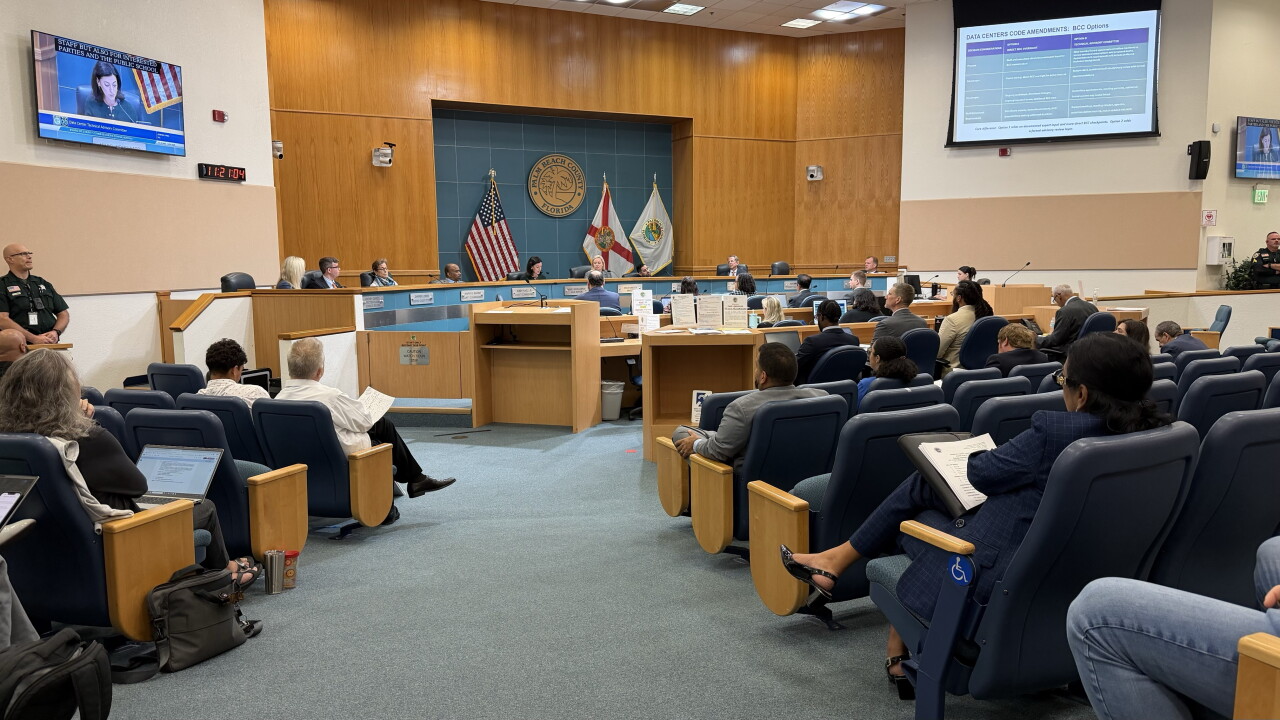


PALM BEACH COUNTY, Fla. — Palm Beach County commissioners unanimously approved a one-year moratorium on the construction of new hyperscale AI data centers Thursday, completing the final vote in a process that began this summer.
WATCH BELOW:
This is an issue WPTV has been following closely for several months. The moratorium adds a definition for a large-scale data center use to the Palm Beach County Unified Land Development Code and establishes a temporary halt on new facilities that meet that definition. The county's zoning commission recommended approval of the measure in August.
The temporary ban gives county officials and staff time to research and draft comprehensive regulations for the fast-growing industry, which has faced increasing public scrutiny. A study from the University of Pennsylvania indicates that approximately 60% of Americans oppose data centers being built in their communities, a significant increase from earlier this year.
The moratorium follows the commission's rejection of Project Tango, a controversial data center expansion proposal near the Arden community, back in July. Residents and commissioners cited concerns that the project could negatively affect nearby homes and Saddle View Elementary School.
The county's action aligns with a national trend, as other local and state governments implement similar moratoriums to better understand and manage AI-related development.
What comes next
During a meeting earlier this year, commissioners and zoning staff discussed a range of potential rules that could be implemented following the one-year study period. Regulations under consideration include:
- Capping a facility's power consumption at 50 megawatts
- Requiring public disclosure of a data center's end-user or operator
- Establishing new restrictions on water use, noise levels and heat emissions
- Creating a permanent task force to monitor the industry's evolution
Palm Beach County Commissioner Marci Woodward said she wants adequate time to hear from experts before the moratorium period ends.
"I want to hear from all the experts myself," Woodward said. "A year could fly by pretty quickly, and so I don't want to be at the end of this trying to cram it into another 12-hour meeting."
Palm Beach County Commissioner Joel Flores emphasized the importance of ongoing oversight.
"Whatever task force we put together should continue to study how this technology continues to evolve and what potential impacts it could play in the future," Flores said.
With regard to data centers, the commission decided to look into hiring a consultant over establishing a committee. Either way, Woodward said the public needs to be involved.
"The public should come, listen, watch, show up, put in a card and speak every single time. I want to hear from them; we all want to hear from them, because this affects them just as much as it affects any of us," Woodward said. "A consultant or a committee, either way the public needs to participate in this."
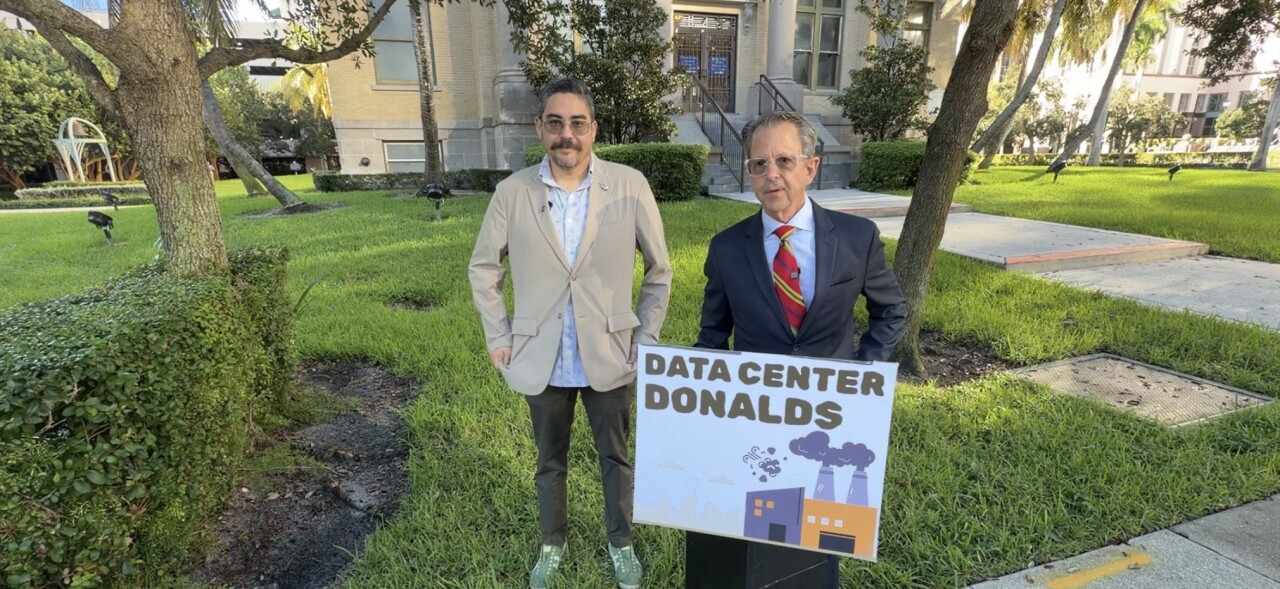
Commissioner Weiss on the moratorium
Palm Beach County Commissioner Gregg Weiss of District 2 said the vote reflects his responsibility to residents.
"It's in my responsibilities to look after the best interests of my fellow residents, and that means not just listening to their concerns but taking action," Weiss told WPTV's Joel Lopez. "And that is important when it comes to the health, safety of our community and when they're at risk,"
Weiss pointed to the rejected Project Tango proposal as a catalyst for the moratorium.
"Right here in Palm Beach County we recently had developers pushing for a hyper scale AI data center right next to a neighborhood and near an elementary school," he said. "Our community knew what happens when a data center comes to town, and we spoke up. Across the country, communities living near data centers have raised issues and concerns about water, electricity usage, wastewater discharges, and noise pollution."
Weiss, a former technology executive who co-chaired a National Association of Counties committee on artificial intelligence in 2023, said he supports AI innovation but not at the expense of communities.
WATCH PREVIOUS COVERAGE BELOW:
"One of the reasons why I voted to deny this project is the sound impact study behind it. It didn't hold up. We're using the wrong metric, one that misses the low hum these facilities produce around the clock. That hum affects somebody's ability to get a good night's sleep or enjoy a quiet time out on their porch," Weiss said. "Palm Beach County has a message loud and clear, and that was hell no on AI data centers near our neighborhoods. I believe the promise of AI, but embracing innovation doesn't mean ignoring impact on our communities."
Weiss also addressed the race for Florida governor and contrasting candidates' positions on data center development.
"Byron Donalds has earned the nickname 'Data Center Donalds,' and it fits. He's told Florida that pristine land is wide open to data centers, and he's told families to trust the process to find the truth about Byron Donalds. Follow the money. Data center developers have sent nearly a million dollars in campaign checks. When your community takes a backseat to donors bankrolling your campaign. You're not looking out for Palm Beach and you're not looking out for Florida," Weiss said. "Families here need a process they can trust. They need a governor who will pause it, study it, and get it right. Floridians across party lines are on the same page. No data centers in our neighborhoods. Byron Donalds wants to rush these projects forward. David Jolly wants answers first, and he's right. That's why I'm proud to stand with David Jolly, and come Nov. 3, I think the voters will do so too."
Residents and environmental advocates weigh in
Several residents who spoke during and after the meeting said the moratorium is only the beginning of a much longer discussion about how Palm Beach County should regulate data centers.
Palm Beach County Democratic Environmental Caucus President Reinaldo Diaz said the moratorium is an opportunity to pause and assess the industry's impact.
"The people who want data centers now and right away are the people who are poised to benefit and profit off of them. Regardless of the cost of the community," Diaz told WPTV's Joel Lopez.
He also raised concerns about the environmental impact of data centers on the Everglades ecosystem, particularly regarding water temperature.
"Palm Beach County is the main connection of sending clean water south to the southern Everglades," Diaz said. "The system starts from the Kissimmee River and goes into Lake Okeechobee, then we ideally want to send it south where the water is nice and clean for the rest of the Everglades, so that it makes its way into Florida Bay."
He said the proposed Project Tango site was particularly problematic from an environmental standpoint.
"If you look at our map and if you were to choose the most egregious spot where you would propose something that generates this amount of heat, it would be where this project is being proposed," Diaz said. "That's at the critical juncture of the L8 Canal, the C-51, and the stormwater treatment areas. That's where that's the only connection if you think of it as pipes, that's the only pipe we have right now that sends water south to the lower Everglades."
Diaz warned that even a small temperature increase from a data center could have significant consequences.
"This is a data center that will raise the temperature to the surrounding area by just a couple of degrees as soon as they turn it on. That's so critically important to the Everglades in the environment raising the temperature by just a couple degrees on water that is already stressed by heat raising temperature of the environment," he said. "You're raising the risk of things like cyanobacteria blooms, other bacteria blooms, poor water quality. That compromises all the effort that has been put into Everglades restoration."

Palm Beach County
Palm Beach County moves toward 1-year ban on new AI data centers
Palm Beach County conservation advocate Sergey Kelley, who addressed commissioners during public comment, called the unanimous vote a significant victory for residents who opposed Project Tango and pushed for stronger oversight of the industry. Kelley argued that public pressure helped change the county's approach and urged officials to use the next year to develop regulations that prioritize environmental protections and local concerns.
"I'm thankful to people speaking up and defending their backyards," Kelley said. "If we didn't speak out and got essentially very mad about it, they would have approved Project Tango and never approved a moratorium."
Kelley said he remains concerned about the potential demands hyperscale data centers could place on water supplies, power infrastructure and environmentally sensitive lands, including wetlands and areas near the Everglades. He also argued that future projects should bear the full cost of any necessary infrastructure and environmental safeguards rather than shifting those expenses to taxpayers or utility customers. "It should not come from our taxes," Kelley said. "The cost should be totally to developers."
He also argued the county's moratorium does not go as far as measures adopted elsewhere in Florida. He noted that Palm Beach County's pause applies to hyperscale data centers as defined by the state at 50 megawatts, while some municipalities have adopted lower thresholds.
"At least six other municipalities have passed a 5- or 10-megawatt ban," Kelley said. He suggested county officials consider stricter limits or a longer moratorium as they spend the next year studying potential regulations, arguing that "50 megawatts still allows a lot of these big buildings."
Meanwhile, Gary Brown, a member of the county's Planning Commission who said he was speaking as a resident, focused on the need for expertise and careful planning before any long-term regulations are adopted. Brown said rapidly evolving technology, environmental concerns and safety considerations make it critical for the county to gather reliable information before making permanent policy decisions.
"This stuff is moving at warp speed," Brown said. "The information you have today is old in a matter of minutes."
Brown supported the commission's interest in hiring a consultant to help evaluate potential impacts and develop recommendations, saying local staff, subject-matter experts and residents should all have a role in the process. He said finding a consultant that have give commissioners the most accurate information would be worth the cost as they decide how and where and how data centers could operate in Palm Beach County.
"Give them the best data to make the best decisions that will protect us all," Brown said.
While Brown said he left the meeting with "more questions" about how the county's review process will ultimately work, he cautioned against rushing decisions involving a technology that is changing rapidly. Invoking a common carpenter's phrase, Brown encouraged county leaders to "measure twice, cut once" as they spend the next year studying the issue and weighing future regulations.
Read more of WPTV's coverage below:
Loxahatchee Acreage
Palm Beach County rejects Project Tango AI data center

Palm Beach County
