

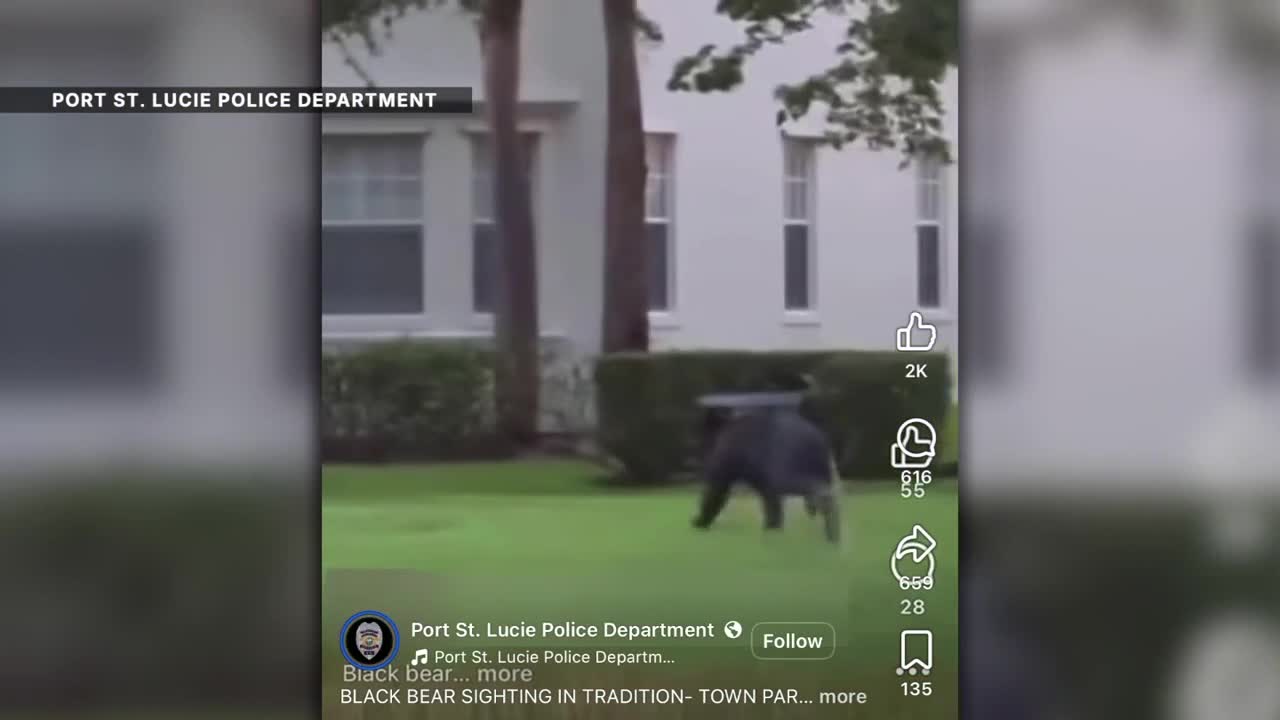


PORT ST. LUCIE, Fla. — Port St. Lucie police shared rare video footage Tuesday of a black bear swimming through a waterway in the Town Park community before exiting the water and running toward nearby homes, marking an unusual wildlife sighting along the Treasure Coast.
The video, posted on the Port St. Lucie Police Department's Facebook page, shows the large black bear navigating through residential waters in what officials described as seasonal behavior for Florida's black bear population.
WATCH BELOW: Black bear swims, runs toward homes in Port St. Lucie neighborhood
The Florida Fish and Wildlife Conservation Commission Bear Management Program said they are monitoring the bear. If it doesn't move from the area on its own, they said their bear biologists may set a trap to try and capture and relocate it.
Bear Activity Increases During Food Search Season
"As Florida's black bears become more active this time of year in search of food, occasional sightings in residential neighborhoods can occur," Port St. Lucie police stated on Facebook. "While seeing a bear may be surprising, it is not necessarily cause for alarm."
According to the FWC, bear sightings remain rare throughout most of the Treasure Coast and Palm Beach County regions, making Tuesday's Port St. Lucie encounter particularly noteworthy for local residents.
WATCH BELOW: Bear spotted in Port St. Lucie
Essential Bear Safety Guidelines for Residents
Wildlife officials emphasize specific protocols when encountering black bears in residential areas. If residents spot a bear, authorities recommend maintaining significant distance, never approaching the animal, and avoiding any attempts to feed it.
Port St. Lucie police advise residents to keep children and pets away from bears and secure potential food sources including garbage, pet food, and bird seed around their properties.
During unexpected bear encounters, officials stress remaining calm and avoiding running. Instead, residents should slowly back away while keeping the bear visible, speak in calm, firm tones, and ensure the animal has a clear escape route.
Growing Statewide Bear Population Trends
The Associated Press reported that Florida's black bears, once listed as threatened, have increasingly wandered into neighborhoods and private properties in recent years, particularly affecting rural areas of north and central Florida.
This population recovery follows decades of conservation efforts, though it has led to more frequent human-wildlife interactions across the state. Florida Fish and Wildlife Conservation Commission data shows the bear population has grown substantially since receiving protected status.
However, bear encounters can pose serious risks. A fatal bear attack occurred last year in rural southwest Florida near Big Cypress Wildlife Management Area, according to state wildlife records.
Preventing Bear Attraction to Neighborhoods
Port St. Lucie police encourage residents to actively remove attractants that might draw bears into residential areas. Homeowners should secure garbage containers, remove bird feeders, and clean outdoor grills regularly.
"If you are letting your dog outside, consider making noise before opening the door and keep dogs on a short leash when possible," police advised. "Dogs can sometimes trigger defensive behavior from bears, especially female bears with cubs."
Wildlife experts explain that Florida black bears typically avoid human contact and move through areas quickly when they cannot locate easily accessible food sources.
When to Contact Wildlife Authorities
Residents should contact the Florida Fish and Wildlife Conservation Commission's Wildlife Alert Hotline at 888-404-FWCC (3922) if they feel threatened by a bear, observe injured or orphaned bears, or witness intentional feeding or harassment of the animals.
Port St. Lucie police said they will continue monitoring the Town Park area situation and remind residents to call 911 for any emergency situations involving wildlife encounters.
The state's management of its recovering black bear population remains active. Florida Fish and Wildlife Conservation Commission officials reported that 52 bears were harvested during the state's first bear hunt in a decade last year, which drew criticism from animal advocacy groups despite agency assurances that the population can sustain limited hunting.
Read the full statement that FWC sent WPTV regarding the bear sighting:
"Currently, staff in the FWC’s Bear Management Program are monitoring this bear. If the bear doesn’t move along from the area on its own, our bear biologists may set a trap to try and capture the bear for relocation.
During the spring and summer, Florida’s black bears are more active and can sometimes be seen in unexpected places. Bears are on the move more this time of year in search of things to eat, including female bears that are teaching their cubs where to look for food. Additionally, juvenile bears (ages 1 ½ - 2 ½) are starting to disperse and leave their mothers’ home ranges and may be seen in unexpected areas as they travel in search of a new location to settle down. In Florida, the breeding season runs from June to August, which can also result in male bears being more active while in search of mates. Bear sightings tend to increase this time of year in suburban and urban areas. Bears in trees may be seeking a safe spot away from people and activity. If you see a bear, give it space, don’t try to approach it, and never feed it.
When bears are observed in neighborhoods, they are either passing through to get from one forested area to another or locating easily accessible food sources like unsecured garbage, pet food or bird seed. Seeing a bear in a neighborhood is not necessarily cause for alarm but it is important that people give it space and secure food attractants so that bears do not linger in the area. To prevent bears and other wildlife from associating your yard with an easy meal, remove potential food sources and attractants – such as unsecured garbage, pet food and bird seed – from around your property. Florida black bears typically try to avoid people but may linger in neighborhoods if they can easily access food sources. Feeding bears can make them lose their natural fear of people. Bears will move on if they can’t find food. Dogs can trigger defensive behaviors from bears, including female bears with cubs. To avoid an encounter between a bear and your dog, bang on your door and flip your house lights on and off to give the bear and other wildlife time to leave the area before letting your dog out. If you do not have a fenced yard, walk your dog on a short non-retractable leash when taking them outside. To learn more about bears and how to avoid conflicts with them, visit MyFWC.com/Bear and BearWise.org.
Staff with the FWC’s Bear Management Program ask that people contact the FWC's 24-hour Wildlife Alert Hotline at 888-404-FWCC (3922) if they feel threatened by a bear; observe a sick, injured, dead or orphaned bear; or to report someone who is either harming bears or intentionally feeding them. Having conflicts with bears? FWC staff are here to help – people can call their FWC regional office: Regional Office Contacts | FWC
The FWC put out a news release on bears being more active this time of year with additional information that should be helpful: What does it mean to be BearWise® this spring?"
This story was reported on-air by a journalist and has been converted to this platform with the assistance of AI. Our editorial team verifies all reporting on all platforms for fairness and accuracy.
