

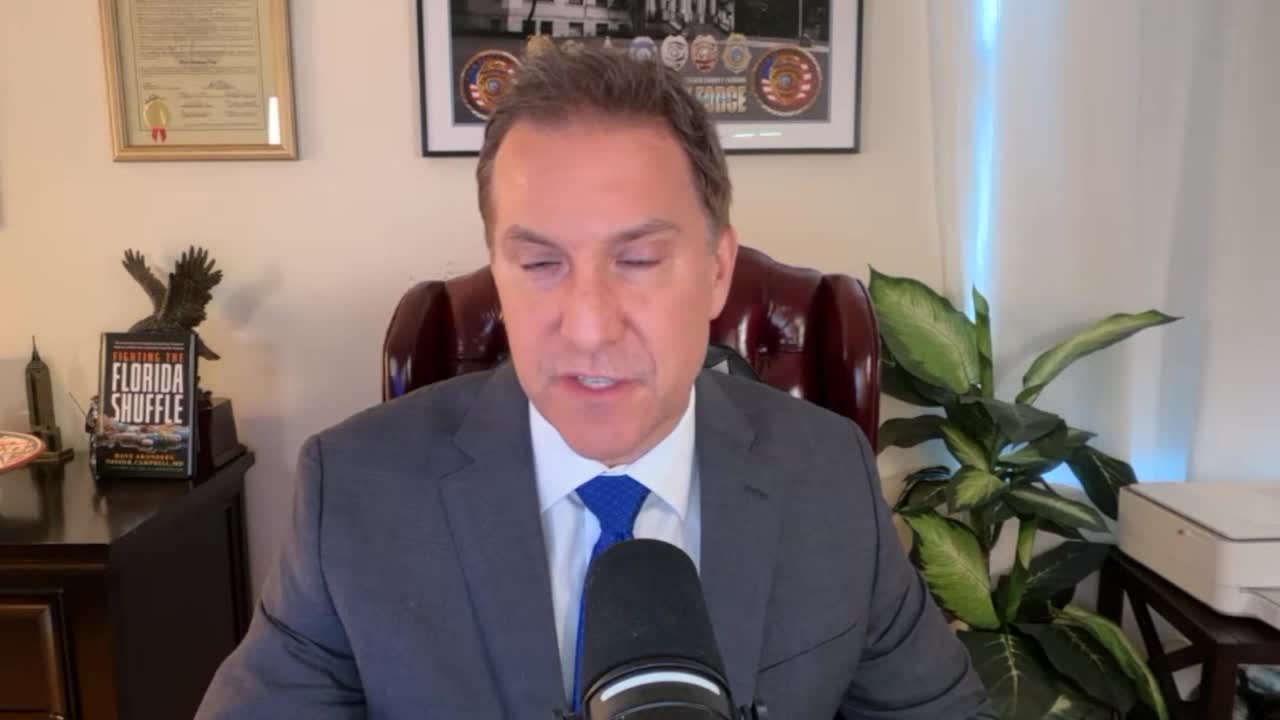


WEST PALM BEACH, Fla. — Florida has secured an arrest warrant charging former Cuban leader Raúl Castro with conspiracy to commit first-degree murder in connection with the 1996 shootdown of two unarmed Brothers to the Rescue planes that killed four men, Florida Attorney General James Uthmeier announced Monday.
The state case comes months after federal prosecutors indicted Castro and others over the same attack, raising questions about what the new Florida prosecution could mean alongside the existing federal case.
WPTV's Michael Hoffman spoke with a former state attorney about the practical impact of the state charges and with a Cuban American woman whose family had a close connection to Brothers to the Rescue.
"It was not an accident what happened. It was murder," Uthmeier said Monday. "The evidence makes abundantly clear that there was a conspiracy."
The Florida Attorney General's Office said its Office of Statewide Prosecution and the Florida Department of Law Enforcement secured the warrant. The state charges Castro with conspiracy to commit first-degree murder.
The 1996 Brothers to the Rescue shootdown
The allegations date back to Feb. 24, 1996, when a Cuban military aircraft shot down two unarmed civilian planes operated by Brothers to the Rescue over international waters.
The four men killed were Carlos Costa, Pablo Morales, Mario de la Peña and Armando Alejandre Jr.
Brothers to the Rescue was a Miami-based Cuban exile organization whose missions included searching for Cuban migrants at sea.
"Raúl Castro called for the planes to be shot down," Uthmeier said. "He called for murder."
According to the state attorney general's office, Castro is accused of participating in a conspiracy involving Cuban spies operating in South Florida who supplied intelligence to Havana.
The arrest warrant affidavitalleges the goal was to kill people aboard the Brothers to the Rescue aircraft "using information provided by spies operating in Miami-Dade and Monroe counties."
Castro already faces a federal prosecution
Florida's case does not stand alone.
Federal prosecutors announced an indictment against Castro in May stemming from the same 1996 shootdown. The state prosecution is proceeding alongside that federal case.
Former Palm Beach County State Attorney Dave Aronberg told WPTV that federal authorities would ordinarily take the lead on a case such as this.
"The federal government usually takes the lead on matters like this," Aronberg said.
Aronberg questioned how much practical effect a state prosecution would have if Castro were ultimately brought to the United States.
"If he is brought to the United States to face justice at all, it'll be by the United States to face federal charges in a federal court and then get federal prison time," Aronberg said.
Uthmeier, however, argued Monday that the state warrant has consequences. He said it could affect Castro's ability to travel internationally if he enters a country willing and legally able to assist with an arrest or extradition. Such an outcome would depend on the country's laws, applicable extradition arrangements and federal cooperation.
Questions about the timing of Florida's charges
The state announcement also brought questions about its timing.
Monday marked the first day of early voting in Miami-Dade County, where Uthmeier is seeking election as attorney general.
Aronberg told WPTV he believes politics played a role.
"I think the timing so close to the election is not a coincidence," Aronberg said. "This is a splash that the attorney general wanted to make, and perhaps it's justified under state law. But the timing does indicate that politics came into play here."
Uthmeier's opponent also criticized the timing in a statement to WPTV.
"If we can arrest the murderous Raúl Castro from Tallahassee, I will be the first to do it as Attorney General," the statement said in part.
The opponent argued that Uthmeier "somehow chose the first day of early voting in Miami-Dade to make this announcement" and called it "a smokescreen to distract from Hope Florida and Alligator Alcatraz."
A personal connection to Brothers to the Rescue
Beyond the legal and political questions, the case remains deeply personal for members of South Florida's Cuban American community.
Hoffman spoke with Mirta Luaces, who said she fled Cuba 65 years ago in search of freedom.
"I came here in search of freedom, the freedom that I have lost in Cuba," Luaces said.
Her son, she said, was a pilot with Brothers to the Rescue and could have been flying with the organization the day of the shootdown.
"The reason why he wasn't flying that day is because he had moved to Daytona, and he wasn't coming every week," Luaces said. "But otherwise, he could have been one of the victims."
Luaces told WPTV she welcomed the new charges and hopes Cuba's political system will someday change.
"I hope that one day the political system in Cuba will change," Luaces said. "We will have free elections, and democracy will take place in Havana, in Cuba again."
Thirty years after the shootdown, Florida's prosecution adds a state case to an already active federal effort to hold Castro accountable. Whether Castro will ever appear in a U.S. courtroom remains an open practical question, but the new warrant adds another legal avenue tied to a case that has remained significant to South Florida's Cuban exile community for decades.
This story was reported on-air by a journalist and has been converted to this platform with the assistance of AI. Our editorial team verifies all reporting on all platforms for fairness and accuracy.
