

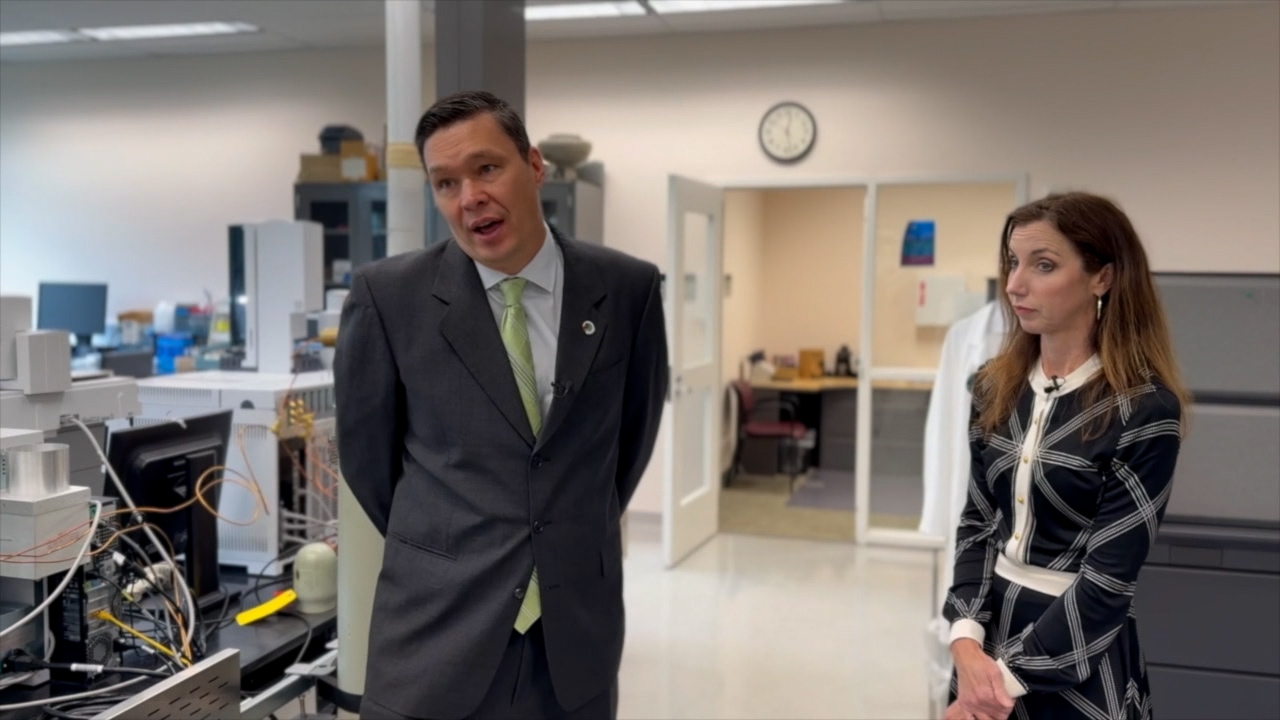


MIAMI — Inside the DEA's busiest drug lab in the heart of Miami, cocaine is king, but fentanyl and carfentanil are now showing up in alarming numbers.
"I see a lot of fentanyl, but even more recently I've seen a lot of carfentanil in my samples; it's scary!" said DEA lab chemist Alyssa Sanchez.
WATCH: Fentanyl and carfentanil make frightening comebacks
Investigative reporter Katie LaGrone and photojournalist Matthew Apthorp recently got a special behind-the-scenes tour of the lab, where forensic chemists spend their days analyzing and testing drugs seized by DEA agents on the streets. The DEA's Miami drug lab is considered the busiest in America due to its location along the coast and its proximity to South America.
"It's not always white. It's any color of the rainbow, really," Sanchez said as she showed us samples of a purple drug containing fentanyl.
Sanchez has been testing drugs at the lab for the last three years and said the amount of fentanyl and carfentanil she is seeing in recent samples is new for her.
"Here we have a fentanyl kilo brick," she said, pointing to another sample. "This turned out to actually be about 16% fentanyl, and it also contains carfentanil, which is a multitude of times more potent than fentanyl."
When asked whether 16% is considered high for a sample of fentanyl, Sanchez didn't hesitate, "yes!"
Fentanyl is a powerful synthetic opioid primarily used to treat pain. According to the DEA and CDC, it is now the leading cause of death for adults ages 18 to 45. It is 100 times stronger than morphine and 50 times stronger than heroin and is considered so potent that as little as 2 milligrams — roughly the size of a grain of salt — can be deadly.
When asked how many people a kilogram brick of fentanyl could kill, Sanchez put it in stark terms.
"Just based on the fact that two milligrams of fentanyl can kill one person, and this has 1,000 grams," she said, adding "a lot."
Carfentanil has no approved human use. It is a tranquilizer for large animals, such as elephants. But after the Chinese government banned the precursor chemicals used to make fentanyl, the DEA says Mexican drug cartels began resorting to carfentanil to make fentanyl and other drugs more potent.
"They obtained chemicals and chemical expertise through the dark web," said Miles Aley, special agent in charge of the DEA's Miami Division.
Aley said fentanyl and carfentanil have become a top agency priority.
While fentanyl and carfentanil overdose deaths are still down from a decade ago, there is no accurate metric to determine whether overall use is down. As we recently discovered, more people are surviving overdoses because of Narcan, an over-the-counter nasal spray that reverses the effects of opioid overdoses — meaning lower death counts do not necessarily reflect lower use.
"We all celebrated when they dropped from 110,000 to 70,000, but 70,000 is really nothing to celebrate. That's far too many deaths," Aley said.
Next month, the DEA will host its inaugural Fentanyl Free America Summit in Orlando. The focus is to raise public awareness about the dangers of the latest fentanyl crisis.
Aley also warned that new drugs are now appearing that are resistant to Narcan.
"They're a different chemical compound that they're immune to the effects of Narcan. It’s very concerning," he said. "There's no single quick answer to solve this problem, and it's going to take a lot of work by a lot of people."