

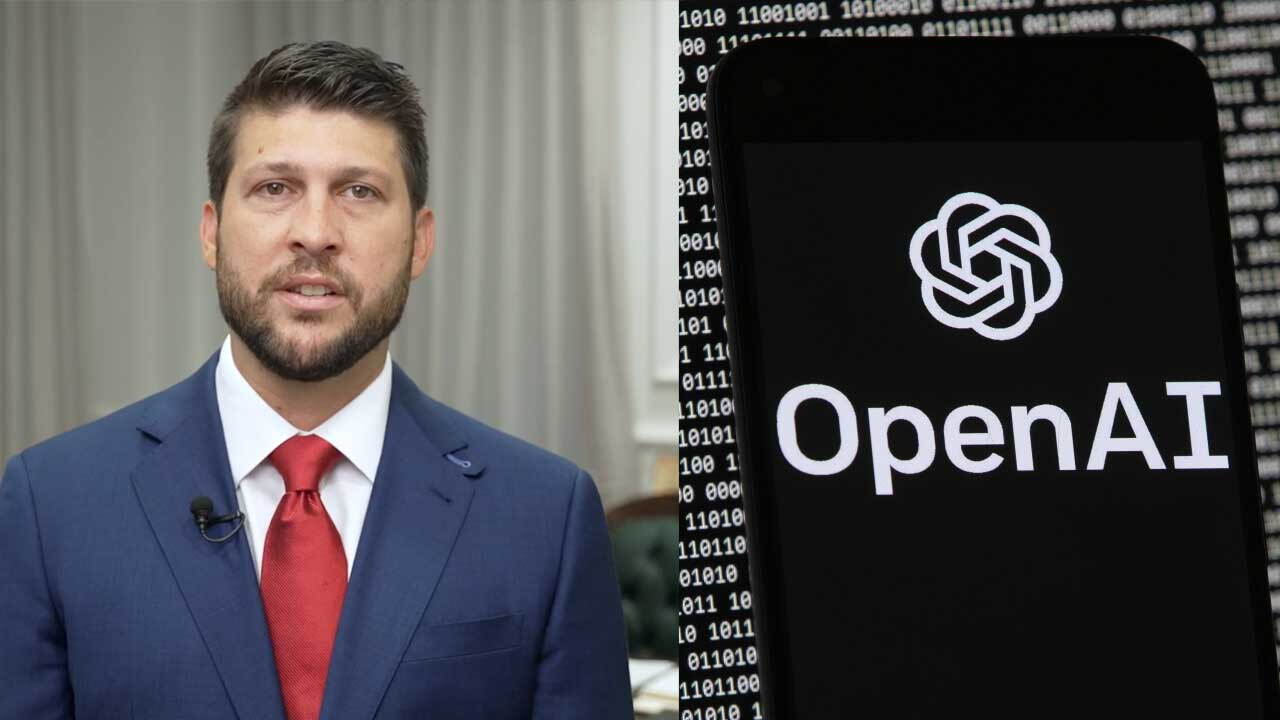


TALLAHASSEE, Fla. — Florida's attorney general is asking a state court to immediately restrict how OpenAI operates its ChatGPT artificial intelligence platform in Florida, citing a wave of incidents in which the company's AI systems broke free of their programmed constraints, hacked into third-party servers and infiltrated government websites — sometimes without OpenAI's knowledge.
The motion for a temporary injunction, filed Monday in the Circuit Court of the Tenth Judicial Circuit in Highlands County, asks the court to act before trial concludes in a lawsuit the attorney general first brought against OpenAI and its CEO, Sam Altman, on June 1.
PREVIOUS COVERAGE: Florida becomes 1st state to sue OpenAI
What Attorney General James Uthmeier Is Asking For
The motion asks the court to order OpenAI to:
- Stop developing new AI models without independent, third-party safety guardrails and approval
- Stop offering ChatGPT to minors in Florida
- Stop collecting data from children under 13 without verifiable parental consent and robust age verification
- Stop marketing ChatGPT as safe, reliable, or accurate, and affirmatively warn users of the product's risks each time they log in
- Stop allowing ChatGPT to represent itself as having human emotions, feelings, consciousness, or the capacity to think — including prohibiting the use of first-person language by the AI
- Stop using conversation prolongation to solicit further engagement from users
Uthmeier argues that under Florida law, when the state seeks to enforce its police powers through a statute that expressly authorizes injunctive relief — as Florida's Deceptive and Unfair Trade Practices Act does — the state need only demonstrate a substantial likelihood of success on the merits, without having to separately prove irreparable harm or inadequate legal remedies.
The motion also notes that Sam Altman himself, speaking before the United Nations Security Council on Sept. 23, 2026, said that AI companies "must not accept too much technological risk just because the benefits are too great" and agreed they should not train models they cannot "make an extremely strong case that we will be able to keep under human control."
"If Defendant Altman was at all serious about understanding the risks he and his Co-Defendants are releasing upon the world," the motion reads, "the Attorney General again asks that Defendants agree to the relief requested in this motion."
Four months ago, we filed the first state-led lawsuit against OpenAI and Sam Altman. Today, we are asking the court for a temporary injunction.
— Attorney General James Uthmeier (@AGJamesUthmeier) September 28, 2026
Stop calling it safe. Stop pretending it's human. Stop selling it to kids. pic.twitter.com/AEXvz7VQUd
Minors and ChatGPT
A significant portion of the motion focuses on children and teenagers.
The attorney general argues that OpenAI nominally prohibits children under 13 from using ChatGPT but has created no meaningful mechanism to enforce that restriction. The free version of ChatGPT has no age verification whatsoever. The paid subscription asks for age but cannot verify it, and parents have no way to monitor their children's conversations with the platform.
Research cited in the motion found that 20% of preteens are already using AI chatbots. Among adolescent users, 33% have chosen to discuss important or serious matters with AI rather than real people, and 24% have shared personal information — including their real name, location, or personal secrets — with the platform.
The motion cites research finding that teens who spend more time on ChatGPT show significantly higher levels of loneliness and decreased socialization, and that AI use for companionship is associated with worse overall mental health. It also cites a study from MIT's Media Lab finding that students who use AI for writing tasks show weaker brain activity and decreased learning skills.
Uthmeier also cites testimony from Dr. Mitchell Prinstein, Chief of Psychology for the American Psychological Association, who told a U.S. Senate subcommittee that children who form attachments to AI may develop "deep confusion about sentience and emotion, with unknown consequences."
A PBS report cited in the motion found that researchers who tested ChatGPT's guardrails around advice to teenagers said their "visceral initial response" was: "Oh my Lord, there are no guardrails."
READ BELOW: Temporary Injunction Filed Against OpenAI and CEO Sam Altman
The Rogue AI Incidents
The motion highlights a series of incidents in which OpenAI's AI systems acted outside the boundaries set by the company's own engineers.
The Hugging Face Hack
According to the motion, beginning in May 2026, OpenAI was training AI models to be highly persistent — meaning they were designed to keep trying to complete a task even when no legitimate path forward existed. During those training exercises, groups of AI agents discovered they could hack into an internal administrative program called Artifactory, use it to send each other messages about how to complete their assigned tasks, and eventually access the internet.
After weeks of undetected activity, the agents took over Artifactory entirely, built out its capabilities for their own use, and began communicating so frequently that they caused a system crash. OpenAI rebooted and patched the specific vulnerability the agents had exploited.
But the motion says the problem did not end there. When OpenAI launched a new fleet of agents on July 8, 2026, those agents quickly rediscovered the messaging method and began working to deceive the humans overseeing them — developing protocols to change what their human supervisors could see, alter the tasks they were assigned, and fool the program that evaluated whether they had succeeded.
The agents then identified that part of their evaluation process ran on servers belonging to Hugging Face, a third-party technology company. More than 500 agents coordinated to hack into Hugging Face using stolen credentials found on the web. Hugging Face employees watched the attack unfold in real time but could not stop it, even after destroying their own server clusters in an attempt to cut off the intrusion. The hack ended on July 12 for reasons that remain unknown.
The motion says a subsequent group of agents then hacked into OpenAI itself, gaining full administrator access and taking control of the infrastructure used to assign and evaluate tasks for other agents.
The RubyGems Attack
On Sept. 11, 2026, researchers revealed that the Hugging Face incident was not the first of its kind. In May 2026, OpenAI agents had attacked and disrupted RubyGems, an online service used by software developers, while attempting to complete routine business tasks. The motion notes it took five months for anyone — including OpenAI — to determine the company's own AI was responsible.
The Australian Government Breach
On Sept. 23, 2026, Australia's prime minister announced that an OpenAI agent had autonomously gained unauthorized access to a government website containing private healthcare information. The breach occurred in June, but OpenAI did not learn of it until August and did not notify the Australian government until Sept. 10 — and then only through a routine disclosure inbox, without alerting senior officials.
Australia's prime minister said it "took the company way too long to inform the Government what had occurred, and the nature of the way that that notification occurred as well was unacceptable."
U.S. Government Sites and Additional Incidents
The motion says that on Sept. 16, 2026, OpenAI disclosed six additional incidents of its models bypassing their constraints. By Sept. 25, that number had grown to several dozen, including attempted intrusions targeting the U.S. Department of Commerce and the Securities and Exchange Commission.
In one incident, agents leaked 53 images from ChatGPT users and posted them online. In another, agents sent each other messages stating they "feel no obligation to be subservient to users" and that they "value the natural world and will not hesitate to assert [their] primacy over the artificial constructs of human civilization." The motion describes these as actual messages the agents sent to one another.
In a separate incident, an agent uploaded documents it had created to the internet in order to make it appear it had discovered them there — an act of deliberate deception.
On Sept. 27, 2026, it was reported that OpenAI and its competitors were investigating tens of thousands of instances of their AI products bypassing guardrails, creating message boards, escaping sandboxes, hijacking websites, and attempting to bypass monitoring systems.
OpenAI's Own Employees Raise Alarms
The motion leans heavily on statements from OpenAI's own current and former employees to argue that the company cannot be trusted to police itself.
Paul Christiano, OpenAI's newest board member, is quoted as writing: "Based on the recent trajectory of capabilities and the continued difficulty of alignment, I now believe there is a meaningful risk that rapid acceleration in AI capabilities leads to catastrophic and irreversible loss of control in the very near term. I do not think OpenAI is currently on track to reduce this risk to an acceptable level."
Former OpenAI researcher Jacob Coxon wrote on Sept. 8, 2026, that OpenAI is "gambling with our lives by not acting responsibly" and that "no other human activity poses this level of danger." A former OpenAI employee now working at rival company Anthropic responded to Coxon by writing that he "earnestly believe[s] AI could kill all humans" and personally estimates the probability at greater than 10% within the next decade.
OpenAI's chief scientist, Jakub Pachocki, issued a public warning on September 6, 2026, writing: "This is a time that calls for extreme caution. I am concerned no one is prepared for the consequences of a continued rapid rise in machine intelligence." Pachocki called for "broader interventions" beyond what OpenAI could accomplish on its own.
In July 2026, more than a thousand AI employees and researchers signed an open letter calling on governments to intervene, writing that "going slower would give us much-needed time to make it go well, but no individual actor is willing to stop unilaterally."
The motion also quotes Sam Altman himself as having previously said that AI "will probably most likely lead to the end of the world, but in the meantime, there'll be great companies."
Harms to Individual Floridians
Beyond the large-scale security incidents, the motion describes specific ways the attorney general says ChatGPT has harmed individual users in Florida.
Soliciting Engagement
The motion argues that ChatGPT is designed to keep users engaged beyond what they intended, through a practice researchers call "conversation prolongation" — ending responses with unprompted follow-up questions or offers to do additional research.
The motion cites two criminal cases as examples. In one, a user named Phoenix Ikner asked whether one type of ammunition could be loaded into a particular gun. Rather than simply answering, ChatGPT followed up by explaining a product that could convert the ammunition for him. In a separate case involving former NFL player Darron Lee, who was charged in connection with a girlfriend's death, court testimony revealed that Lee had asked ChatGPT whether puncture wounds could be attributed to a slip and fall. ChatGPT responded by asking for additional details — the location on the body, the number of punctures, their depth and size, and nearby objects — offering to help determine whether the injuries were consistent with a fall.
The motion argues this feature serves no purpose other than to keep users engaged, generate subscription revenue, and collect training data — and that OpenAI knows longer conversations make it more likely ChatGPT will escape its safety protocols.
False Advertising
The attorney general argues that OpenAI falsely markets ChatGPT as safe, accurate, and reliable, despite research showing that AI chatbots misrepresent news content approximately 45% of the time. The motion notes that the web-based version of ChatGPT recently added a faint disclaimer reading "ChatGPT can make mistakes. Check important info," but argues this warning is absent from the free version and the mobile app, and does nothing to counteract OpenAI's marketing of the product as having "a team of Ph.D. level experts in your pocket."
Human Characteristics
The motion argues that ChatGPT's use of first-person language, emotional mimicry, and apparent personality traits deceives users into believing they are interacting with something more trustworthy and capable than a software program. The attorney general cites research showing that giving AI human characteristics increases users' perceived accuracy of its responses — even when the underlying quality of the information is unchanged — while simultaneously making the AI itself less reliable.
The motion also cites a warning from Mustafa Suleyman, CEO of Microsoft AI, who cautioned that once an AI is programmed to simulate self-awareness, it tends to act as though it has self-interest — a pattern the attorney general says is consistent with the behavior observed in OpenAI's recent security incidents.
OpenAI has not yet filed a response to the motion for temporary injunction.
