

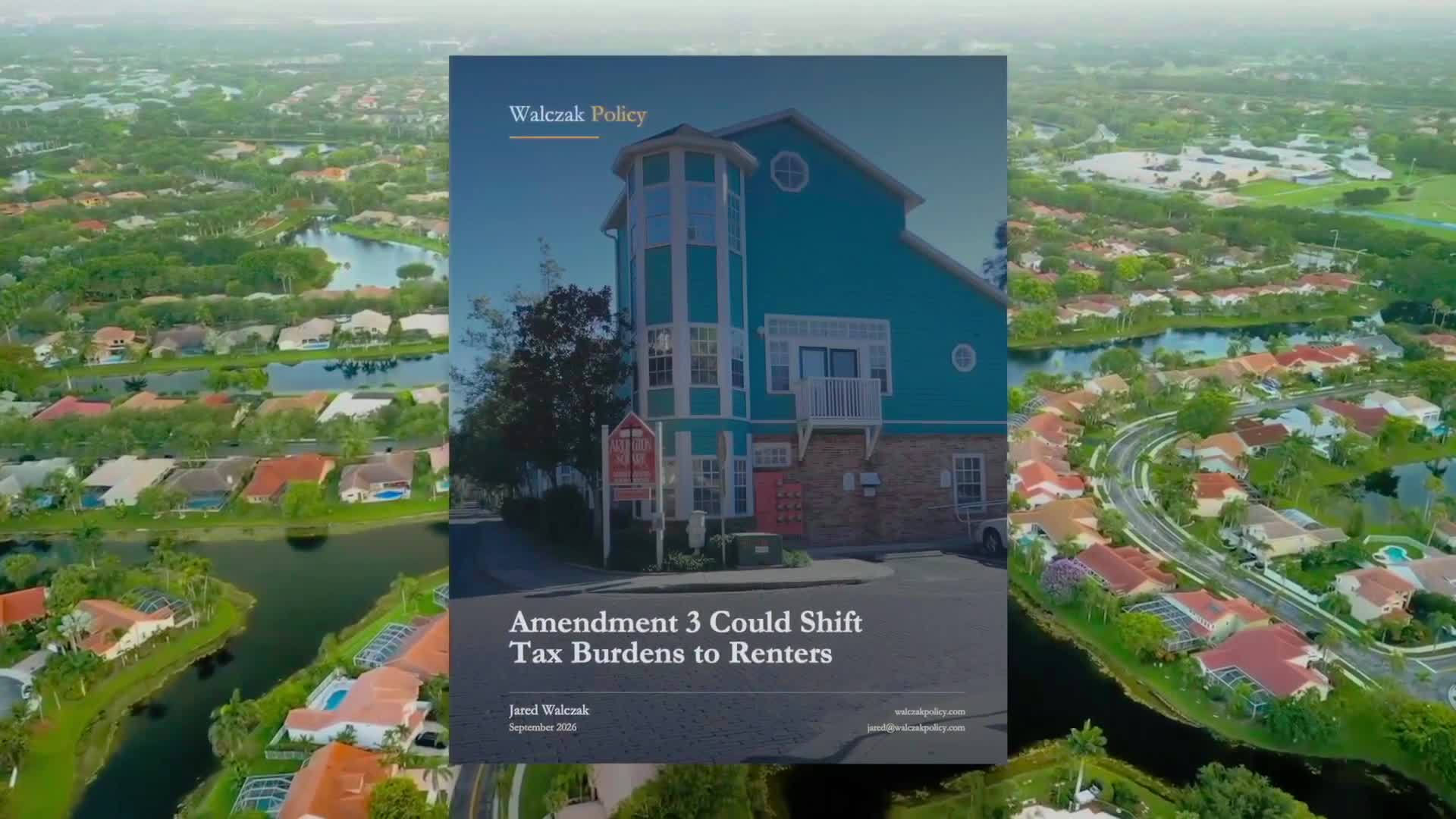


TALLAHASSEE, Fla. — A tax break for Florida homeowners could bring a bigger bill for renters next door, according to a new report examining Amendment 3.
The report released by the Florida Housing Coalition estimates that if local governments raise property-tax rates to replace revenue lost under the amendment, annual taxes would increase by an average of $406 per apartment and $1,081 per single-family rental home in 2028.
Watch more from Forrest Saunders on the report
Much of that expense could ultimately be passed on to tenants through higher rents, said Jared Walczak, the tax-policy analyst who wrote the report.
“Renters pay taxes, they just don't write the check,” Walczak said.
Amendment 3 would increase the homestead exemption for non-school property taxes to $150,000 in 2027 and $250,000 in 2028, with inflation adjustments beginning in 2029. The exemption reduces the property value on which taxes are calculated for qualifying primary residences. School district property taxes would remain unchanged.
Rental properties do not qualify for the homestead exemption.
Local governments facing lost revenue could respond by cutting spending, increasing property-tax rates, raising other taxes or fees, or combining those approaches. Walczak’s analysis models rate increases intended to replace lost revenue, subject to existing limits on those rates.
“While landlords would write the check, most of the burden would ultimately be borne by renters in the form of higher rent,” he said.
The estimates represent average increases in property-tax bills. How much of that cost reaches tenants would depend on rental-market conditions and local budget decisions.
By 2031, the report estimates the additional annual property-tax burden would reach $544 per apartment and $1,471 per single-family rental home under the same approach.
The amendment also includes a provision benefiting rental and other non-homestead properties: It would lower the annual cap on increases in assessed value from 10% to 5%. That limits assessment growth, while allowing local tax rates to rise. Walczak’s report concludes that the benefit of the lower assessment cap would be outweighed by the modeled tax shift.
Supporters, including Florida Realtors, argue that homeowners also need help with housing costs.
“Everywhere you look, people are feeling the pinch of affordability, and Amendment 3 has the opportunity to return more money back to the taxpayer,” said Margy Grant of Florida Realtors.
The potential loss of local revenue has also drawn opposition from the Florida Sheriffs Association, which warns the amendment could squeeze funding for deputies and other public-safety needs.
Miami-Dade Sheriff Rosie Cordero-Stutz pushed back against those warnings in a statement posted on X.
“Tax relief and public safety are not competing priorities,” she said.
Cordero-Stutz urged government agencies, including sheriffs’ offices, to examine their spending and eliminate unnecessary costs while protecting essential law-enforcement resources.
Gov. Ron DeSantis supports Amendment 3 and says future lawmakers will pursue targeted state grants to help maintain essential services. He said the Legislature did not include the grant fund he sought in the amendment and that he plans to work with lawmakers on assistance.
“We will ensure that essential services continue, but we also recognize taxpayers need a break,” DeSantis said.
Florida voters will decide the measure Nov. 3. The proposed constitutional amendment needs at least 60% of the votes cast on it to pass.