



DELRAY BEACH, Fla. — Delray Beach is updating its noise ordinance to set defined decibel limits for businesses and vehicles, in areas along Atlantic Avenue.
Atlantic Avenue in Delray Beach is known as one of South Florida's most popular nightlife destinations — lined with shops, bars and restaurants.
WATCH: Delray Beach draws a new line on noise
But the city is now drawing a clear line on how loud is too loud.
For years, Delray Beach's noise ordinance relied on a subjective standard: whether noise from a bar or restaurant could be heard 100 feet away.
The problem was that what sounded excessive to one person seemed perfectly fine to another. It was too subjective, making it difficult to enforce.
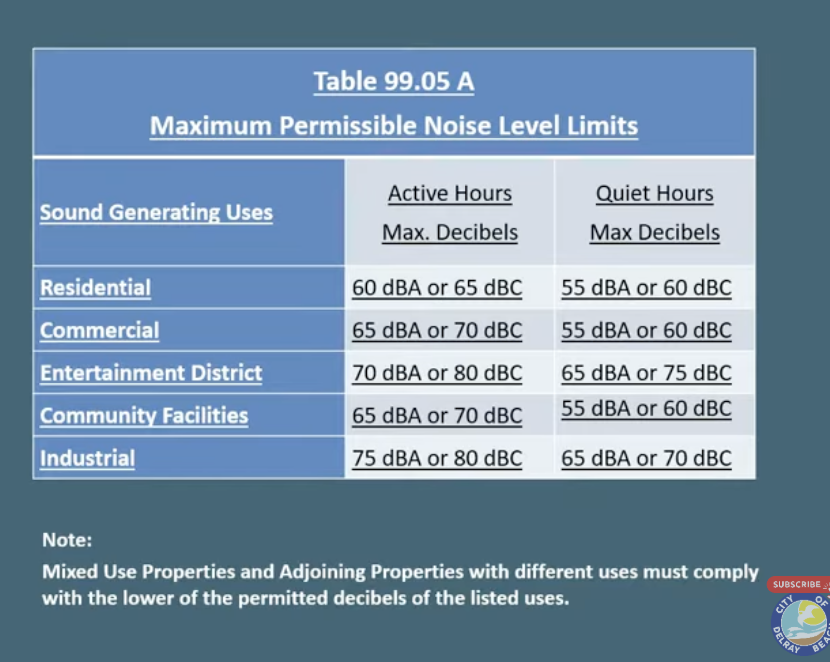
Under the updated rules, the city is replacing that standard with defined decibel limits that vary based on time of day and location.
The new rules establish two time categories: "active hours," running from 7 a.m. to 10 p.m. citywide, and "quiet hours" after that.
The entertainment district — which begins east of Swinton Avenue — gets extended active hours until 1 a.m. on weekends and will be held to higher noise thresholds than residential areas, which face the strictest limits under the new regulations.
The overhaul also takes aim at noisy vehicles, which the city says have generated a significant number of complaints.
"The vehicles, the loud music that comes out of the vehicles, the motorcycles that are really loud. There's a lot of outdoor seating and when they come by it's very disruptive," said Stella Jurkiewicz, who has lived in Delray Beach for over 20 years. "There's more and more people coming here and it's just more and more noise."
Jurkiewicz said she supports the new ordinance for the traffic noise, not so much for the businesses.
"I'm happy for the noise ordinance, I think that will help," Jurkiewicz said.

Delray Beach
New Delray Beach noise ordinance moves forward with strict rules city-wide
Not everyone shares that view.
Brad Manfredonia and Brenda Webster were visiting Delray Beach from Iowa to celebrate Manfredonia's birthday.
Both said they oppose setting stricter noise limits.
"You don't want to have to worry about how loud it is, you just want to enjoy the music and what better place with weather like this?" Manfredonia said. "If you want to come up to Iowa, and you can live out in the middle of the corn fields where it will be quiet."
Webster said her concern is the potential impact on local businesses that depend on live music and entertainment.
"They're going to suffer because you come down here, you have fun, you spend money, that's what you come down here for," Webster said.
Jack Wilkie, who lives in downtown Delray Beach, said the noise level is generally acceptable — though he acknowledged location matters.
"Part of the charm of the town is you know, it is a little bit noisy, right?" Wilkie said. "Luckily I live on the internal side of building but if I lived on the same side of Throw [Social] I think I would complain a little bit more about, 'Hey, you know the noise could be kept better in check.' Maybe we could do some decibel-reading-type stuff but if you're living downtown that's what you're signing up for so it comes with the territory."
The boundary line for the entertainment district became a flashpoint at this week's city commission meeting, where several residents argued that limiting extended noise allowances to areas east of Swinton Avenue creates an inequity for businesses and residents to the west.
Angela Hill, a Delray Beach resident, said the divide reflects a deeper imbalance in how different parts of the city are treated.
"On the east side, entertainment is understood as part of an environment. And on the west side, it is treated as a disruption," Hill said.
Hill also called on commissioners to expand the entertainment district westward.
"We cannot celebrate diversity while preserving visible invisible borders," Hill said. "The community asked that you extend the entertainment district to the westward, not just for businesses, not just for music, but for fairness and equality to all. Because sometimes equity simply means removing the last remaining line and making it visible."
Alex Burns, co-owner of Studio 404 — a frozen bar and cafe west of Swinton Avenue with a patio used for events and entertainment in a historically Black part of Delray Beach — echoed those concerns.
"With the second largest community, if that community started making money, it only uplifts the whole city, right? So we talk about taxes and money and not having enough to pay for things. Well, I guarantee you if we fix that second largest community being on the bottom of the totem pole issue, Delray would be thriving," Burns said.
Commissioner Juli Casale spoke with WPTV in January about the reasoning behind the ordinance update.
"With all of that, you get more noise and more people in close proximity, so we're just again, trying to balance the quality of life of the residents with the success of the businesses," Casale said.
To enforce the new rules, code enforcement officers will use approximately five sound meters, each costing approximately $7,000. First-time offenders will receive warnings. Second offenses carry a $500 fine, with fines starting at $250 for initial violations.
Over the next couple of months, the city will purchase the meters, train staff and conduct community outreach with businesses to ensure everyone understands the new rules.
City commissioners noted that the noise limits are not final and may be adjusted as enforcement gets underway. The city expects to begin enforcement by May.
