



BOYNTON BEACH, Fla. — Boynton Beach commissioners have approved utility rate increases and a reduced property tax rate as city leaders work to fund a massive overhaul of the city's aging water system.
Officials say roughly $325 million in improvements are needed at Boynton Beach's two water treatment plants, which they say are aging, increasingly difficult to maintain, and facing new federal drinking water requirements.
WATCH BELOW: Pay more for water, less in taxes? The trade-off approved in Boynton Beach
"Both plants are at the end of their useful life, which means they can break down at any time. We're not even able to get parts for some of that stuff because it's become obsolete," Utilities Director Poonam Kalkat told commissioners, warning the city's infrastructure is becoming harder to maintain.
"They are 65 and 45 years old, and we've been putting Band-Aids on them for years and years and year and years," Vice Mayor Thomas Turkin said. "Every time we didn't increase the rates, we put on bigger Band-Aids."
The commission voted to move forward with the project and the rate increases needed to help fund it.
City officials said much of the cost is tied to new federal PFAS treatment requirements. PFAS, often called "forever chemicals," are a group of man-made substances that have become the focus of stricter drinking water regulations nationwide.
"Most of this increase is because of the regulatory requirements for PFAS treatments at the two plants," Kalkat said during a previous budget workshop. "The probable cost for implementing this PFAS treatment at both plants is going to be close to $300 million."
Officials said years of keeping rates relatively low also contributed to the situation.
"Over those last four years we've done a number of other really big benefits that you all have moved forward with," rate consultant Ryan Smith said. "We've come up with what the actual improvements need to be made at both water treatment facilities, and staff has identified approximately $30 million in grants and other proceeds that have been available to also kind of offset as much of this near-term capital as we can."
City Manager Dan Dugger said the city is now dealing with the consequences of years of underinvestment.
"Our predecessors failed to do what was just to provide the utility department the resources that they need to make sure that we're able to provide clean, safe drinking water to all of our residents. And that's why we're here today."
Not everyone was happy about the rate increase.
"But these rate increases that we have had with utilities have really hurt. I have watched my water bill," one resident told commissioners during public comment.
According to city figures presented during the meetings, the typical residential customer using 5,000 gallons per month currently pays about $65.83 per month for water and sewer service. Under the approved rate structure, that bill would increase to approximately $77.19 per month, or about $11.36 more each month and roughly $136 more annually.
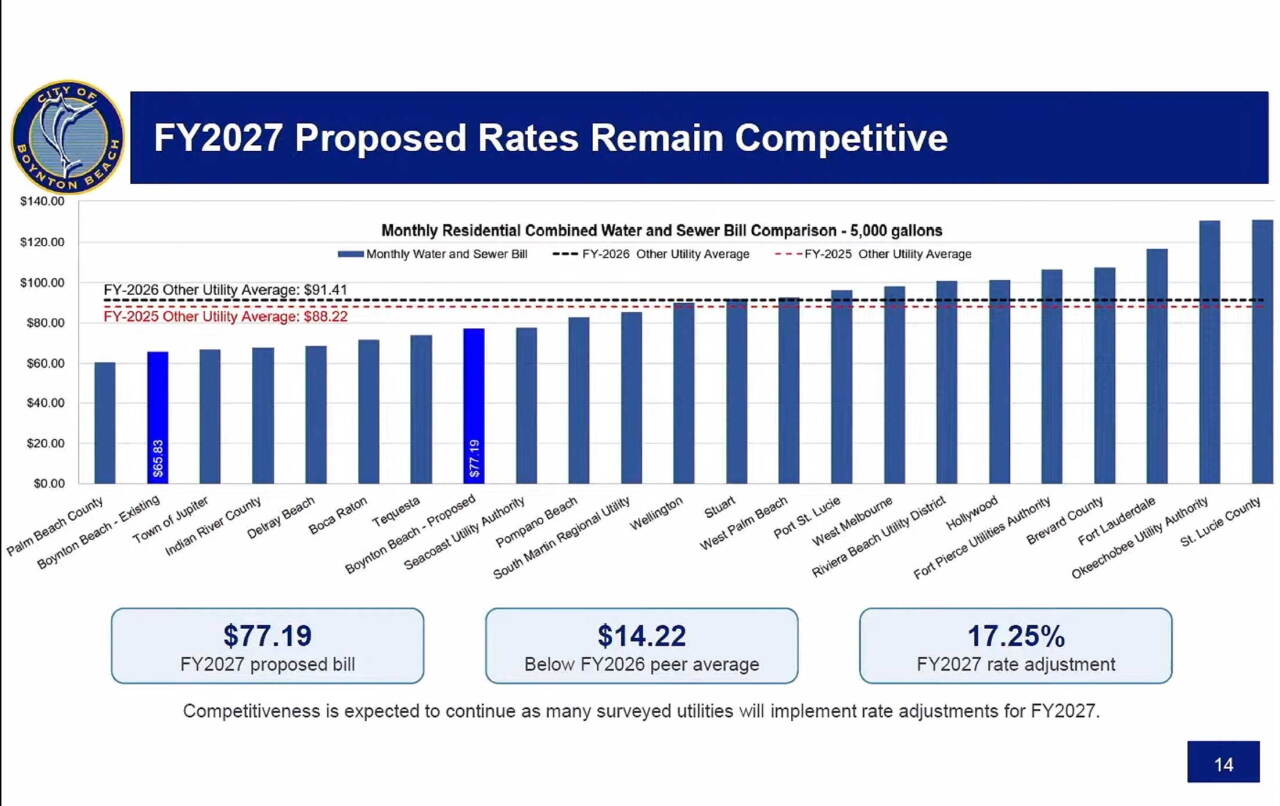
Despite the increase, the city's consultant said Boynton Beach would still remain below many neighboring utility systems.
"We will still be below our other surveyed utilities by approximately $14," Smith said.
Commissioners acknowledged the impact the increase could have on residents, especially seniors and people living on fixed incomes.
"There have to be alternative ways to raise this revenue where our oldest and most vulnerable citizens on fixed incomes are protected," one resident told city leaders.
In response to those concerns, commissioners voted to reduce the city's property tax rate, known as the millage rate.
City staff said the lower millage rate is expected to largely offset the utility increase for many residents.
"If we go back and we move the millage rate to 7.2, I did the math," Dugger said during budget discussions. "The math is going to be there is virtually in between zero, in some cases negative, to about a dollar is what we're expecting the impact of the monthly impact to be."
The approved millage rate of 7.2052 mills is about 3% below the rollback rate of 7.4257 mills.
Officials said the lower tax rate will require the city to use about $1.8 million from reserves but argued it provides needed relief while still allowing critical utility upgrades to move forward.
Staff also noted that utility customers outside city limits already pay a 25% surcharge on their rates to help cover infrastructure costs.
"If you're outside of the city limits, you get a 25% surcharge attached to your utility rate and that's put in place for infrastructure repairs and things of that nature," Dugger said.
Throughout the debate, city leaders stressed they were trying to avoid larger problems and higher costs in the future.
Turkin said years of deferred maintenance have left the city with few alternatives.
"Our aging facilities have been neglected for years and years," he said. "We've been putting Band-Aids on them for years and years and years."
Turkin warned that failing to make the upgrades could eventually jeopardize the city's ability to maintain control of its own water system.
"The alternative is, we lose our water plants," he said.
For city officials, the goal is to make painful investments now to avoid even bigger costs later.
"If you fund the plants, infrastructure-wise we're in a good place," Kalkat said.
This story was reported on-air by a journalist and has been converted to this platform with the assistance of AI. Our editorial team verifies all reporting on all platforms for fairness and accuracy.
