

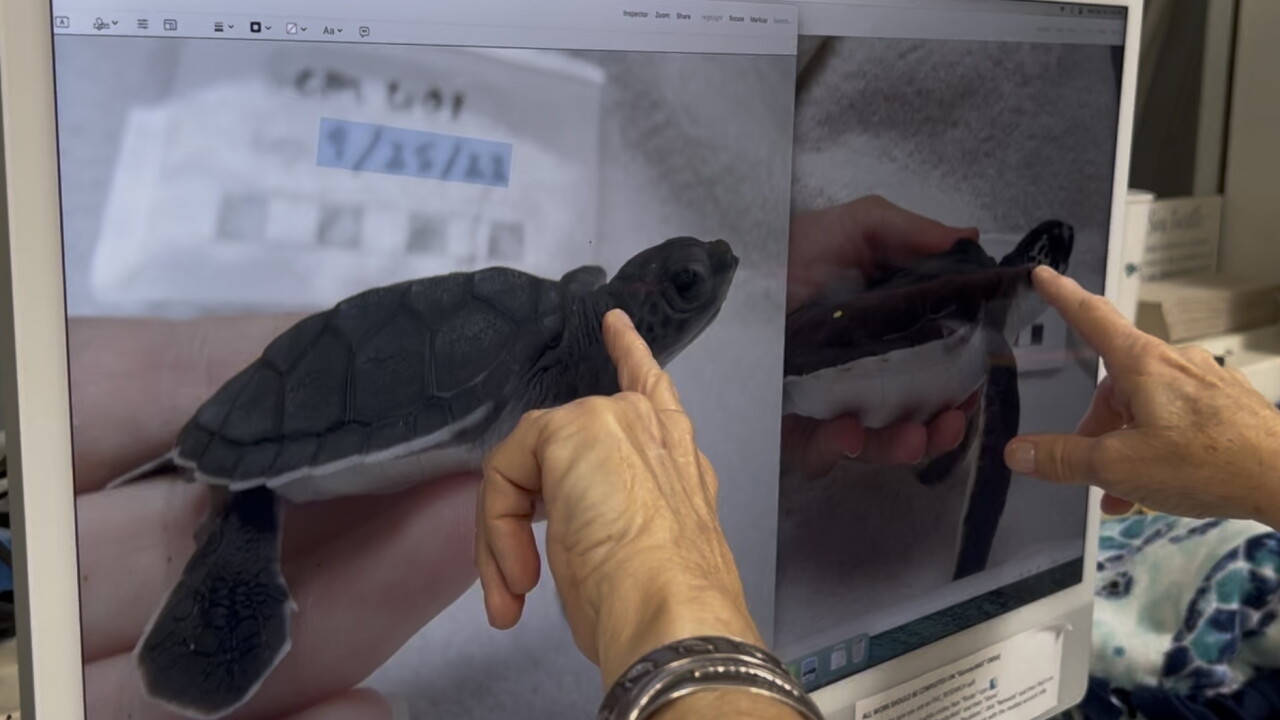


BOCA RATON, Fla. — We watch baby sea turtles emerge from nests along South Florida’s beaches and make their way toward the Atlantic.
But once they disappear beneath the surface, one big question remains: Where do they go?
Researchers at Florida Atlantic University’s Marine Science Laboratory at the Gumbo Limbo Environmental Complex are using tiny satellite transmitters to help answer that question.
The trackers are small, some roughly the size of a thumbnail, but the information they can send back could help scientists better understand one of the least visible stages of a sea turtle’s life.
“We’ve been working on how to satellite tag the littlest life stages,” said Jeanette Wyneken, professor of biological sciences and director of the FAU Marine Science Laboratory. “We have some little tiny satellite tags — they’re about the size of my thumbnail.”
Why track young sea turtles?
For researchers, knowing a turtle’s location is only the beginning.
Tracking can help scientists understand where young turtles travel after release, which parts of the ocean they use, and what types of conditions they encounter along the way.
That information may also reveal whether their routes take them into healthier habitats or areas where they face greater risks.
Wyneken describes it as figuring out whether the turtles are moving into the ocean’s “good neighborhoods” or its “bad neighborhoods.”
“Are they going to the good neighborhoods, the bad neighborhoods — the bad ones being ones with lots of garbage or lots of fisheries bycatch issues?” she said.
Those threats can include marine debris, plastics, discarded fishing gear, and areas where turtles may be at greater risk of becoming unintentionally caught in fishing activity.
By identifying where young turtles spend time, researchers can begin building a better picture of which ocean habitats may be especially important during their early lives.
Following turtles from a distance
The satellite tags give researchers a way to continue collecting information after the turtles leave the laboratory.
Researchers have also learned more about how long they can continue receiving data as the turtles grow.
Wyneken said the tag attachment allows young loggerheads to grow several centimeters before the transmitter eventually falls away.
Under temperatures similar to those the turtles experience in the Gulf Stream, researchers estimate that can provide roughly 70 days of tracking data.
That gives scientists a limited but valuable window into the turtles’ lives after they return to the ocean.
Into the Gulf Stream
Some of this season’s turtles are already giving researchers clues.
“We just released some leatherbacks with satellite trackers, and they got into the Gulf Stream,” Wyneken said. “And last I checked, they were still in the Gulf Stream.”
The Gulf Stream runs just offshore of Florida’s Atlantic coast, carrying warm water northward through the Atlantic.
For researchers, seeing the turtles enter that current is more than an interesting point on a map.
It helps show how young turtles move through the ocean after leaving South Florida and provides another piece of information about the habitat they use during a critical stage of their development.
That information can help scientists better understand which ocean habitats young sea turtles depend on — and where conservation efforts may be most useful.
How you can help
Researchers say funding is an important part of continuing and expanding this work.
Support helps cover the care of turtles being studied as well as equipment used for research, including satellite-tracking technology.
FAU’s Marine Science Laboratory provides information about its sea turtle research, ways to support the program and opportunities for the public to learn more about the work.
The laboratory also works with Upwell, a nonprofit organization involved in sea turtle tracking and conservation research.
You can also learn more about the lab’s sea turtle research and visit the public gallery at the Gumbo Limbo Environmental Complex in Boca Raton. Support FAU’s Marine Science Laboratory at Gumbo Limbo
Viewers can also help protect sea turtles by keeping beaches clean, removing trash and discarded fishing line, limiting artificial light near nesting beaches, and give hatchlings and nesting turtles plenty of space.
