
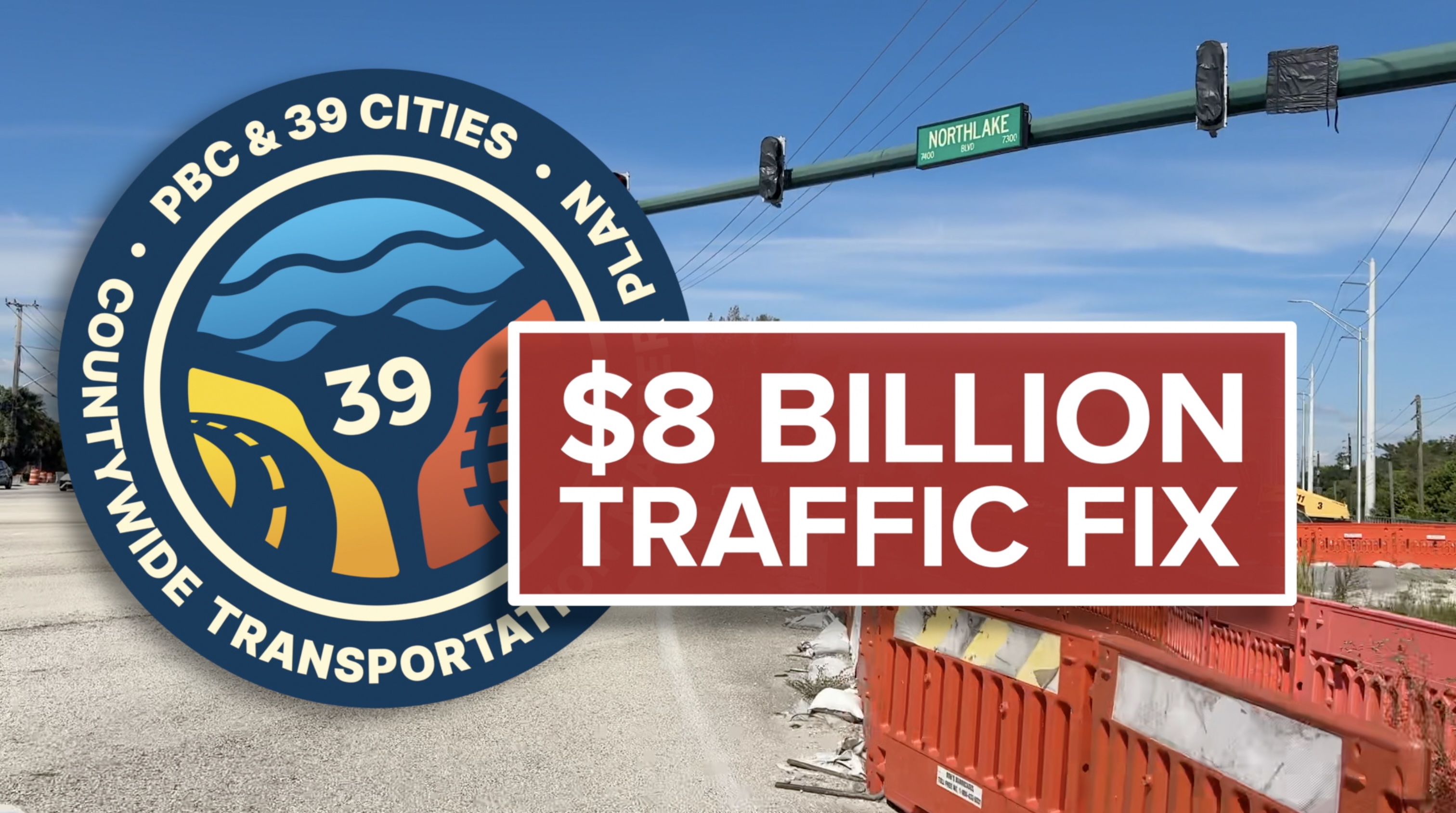


PALM BEACH COUNTY, Fla. — WPTV is looking for solutions to fix some of Palm Beach County's biggest traffic headaches and learned it could come with a price tag of roughly $8 billion, according to a countywide transportation study that identified the area's worst congestion hotspots and potential solutions.
Palm Beach County commissioners recently reviewed the Countywide Transportation Master Plan, a long-term roadmap aimed at addressing growing congestion and failing infrastructure as more people move to the county.
WATCH BELOW: Study: Traffic solutions carry $8B price tag in this county
The study identified Northlake Boulevard, Southern Boulevard and Old Dixie Highway as the county's most congested corridors.
For drivers, the findings come as no surprise.
"Uh, terrible," said Kathryn Buscemi when asked how she would describe traffic along Southern Boulevard.
"We need wider roads, more lanes," said Barry Getzof, who frequently commutes on Northlake Boulevard.
The transportation study analyzed roadway conditions, speed data and delays across Palm Beach County. Consultants told commissioners that fixing roadway issues alone could cost nearly $2 billion, while the broader transportation vision, which includes transit options and technology upgrades, would cost about $6 billion.
"It's a lot of money, but we do need to alleviate traffic," Getzof said.
According to the plan, Northlake Boulevard ranked as the county's most congested corridor, followed by Southern Boulevard and Old Dixie Highway. Other problem corridors identified in the study include Palmetto Park Road, Military Trail, Okeechobee Boulevard, Glades Road, Atlantic Avenue, Boynton Beach Boulevard and PGA Boulevard.
For commuters dealing with daily backups, the frustration continues to build.
"It's very frustrating cause I'm always going somewhere when I have to sit in bumper-to-bumper traffic just to get to Beeline," Getzof said.
Buscemi said traffic conditions often dictate her travel plans.
"I always look at my app before I get on the road to see if it's flowing; if anything has happened, I usually avoid it," she said.
County leaders discussed a variety of potential improvements beyond simply adding lanes. Among the ideas are adaptive traffic signals, transit alternatives and flex lanes, which would shift direction based on traffic demand during peak travel times. Consultants told commissioners those types of operational improvements could reduce delays and improve travel times on some of the county's busiest roads.
Upgrades to the county's Traffic Management Center would save someone 25 hours annually for someone who makes two 30-minute corridor trips on 250 weekdays.
"We always need more time so you don't want to spend your time commuting," Buscemi said.
Palm Beach County Commissioner Gregg Weiss argued that reducing congestion isn't just about roadway improvements but also about giving people back valuable time.
"Nobody has ever calculated the value of people's time. To me that is one thing none of us ever get back, and it is the most valuable thing that we have," Weiss said during the meeting.
Vice Mayor Marci Woodward pointed to signal improvements as one of the quicker solutions available.
"It's not going to be next week," Woodward said. "That is something that does not require major construction and design and all the other stuff. The intersections are there."
Woodward also highlighted flex lanes as a possible way to maximize existing roadway capacity without building new roads.
"The road is not at capacity; that one direction is," Woodward said while discussing traffic patterns on Glades Road.
County leaders also discussed modernizing the transportation management system. Consultants estimated improvements to traffic management technology could save commuters significant travel time on heavily traveled corridors.
"I can't put that into actual terms of what it's worth, but we do need to alleviate the traffic because it's only going to get worse," Getzof said.
Not everyone focused on roadway expansion. Palm Beach County Commissioner Maria Marino emphasized practical transportation improvements over expensive rail projects, pointing to lower-cost solutions that could improve traffic flow more quickly.
Marino specifically highlighted bus pullout areas, noting that buses stopping in travel lanes can create backups on major corridors.
"I think people would appreciate having that," Marino said. "I think those are low-hanging fruit."
She also expressed skepticism about investing heavily in rail, reflecting a broader discussion among commissioners about prioritizing intersection improvements, signal upgrades and other congestion-relief projects that could be implemented sooner.
Still, the overall price tag raised questions among residents.
"That sounds like a lot of money, but it just depends on how it's taken from our taxes," Buscemi said.
For now, no transportation projects have been approved. Commissioners voted to receive and file the master plan while continuing discussions on priorities, costs and implementation.
County leaders said collaboration will be critical moving forward because many of the identified corridors cross county, municipal and state jurisdictions, and future funding could involve local, state and federal partners.
This story was reported on-air by a journalist and has been converted to this platform with the assistance of AI. Our editorial team verifies all reporting on all platforms for fairness and accuracy.