



PALM BEACH COUNTY, Fla. — After five Palm Beach County Sheriff's Office deputy-involved shootings since August, WPTV is taking a closer look at how the agency trains deputies for critical encounters where decisions can be made in a matter of seconds.
The Palm Beach County Sheriff's Office invited WPTV's Michael Hoffman inside its immersive training simulator, which puts deputies through scenarios ranging from active shooters and potentially deadly encounters to situations where no lethal force is necessary.
Hoffman participated in the training firsthand, experiencing how quickly a situation can develop and how deputies are expected to decide whether to escalate, de-escalate or rely on communication alone.
Five deputy-involved shootings since August
The training comes at a time following five deputy-involved shootings involving the Palm Beach County Sheriff's Office in recent months.
Those incidents happened in:
- West Palm Beach on Aug. 6
- South Palm Beach on Sept. 17
- Boynton Beach on Oct. 13
- Boca Raton on Oct. 28
- Jupiter on Nov. 10
Each incident carries its own circumstances, but collectively they raise questions about how deputies prepare for encounters in which rapidly changing conditions can force them to make consequential decisions.
To better understand that training, Hoffman went through it.
Simulator can escalate or de-escalate based on deputies' actions
Inside the simulator, deputies face a wide range of scenarios.
"We go from active shooter, and we have ones that are just completely, there's going to be no lethal force," Cpl. Capobianco, a PBSO training deputy, said.
The training isn't necessarily limited to a predetermined outcome.
According to Capobianco, trainers can change how a scenario develops depending on how the deputy interacts with the person on screen.
"We're able to choose different, how should I say, different like categories to select from to escalate, de-escalate the situation, all based off of how the deputy's communicating to the screen and how the scenario is reacting from there," Capobianco said.
That means a deputy's words and actions can influence what happens next.
From firearms to less-lethal options
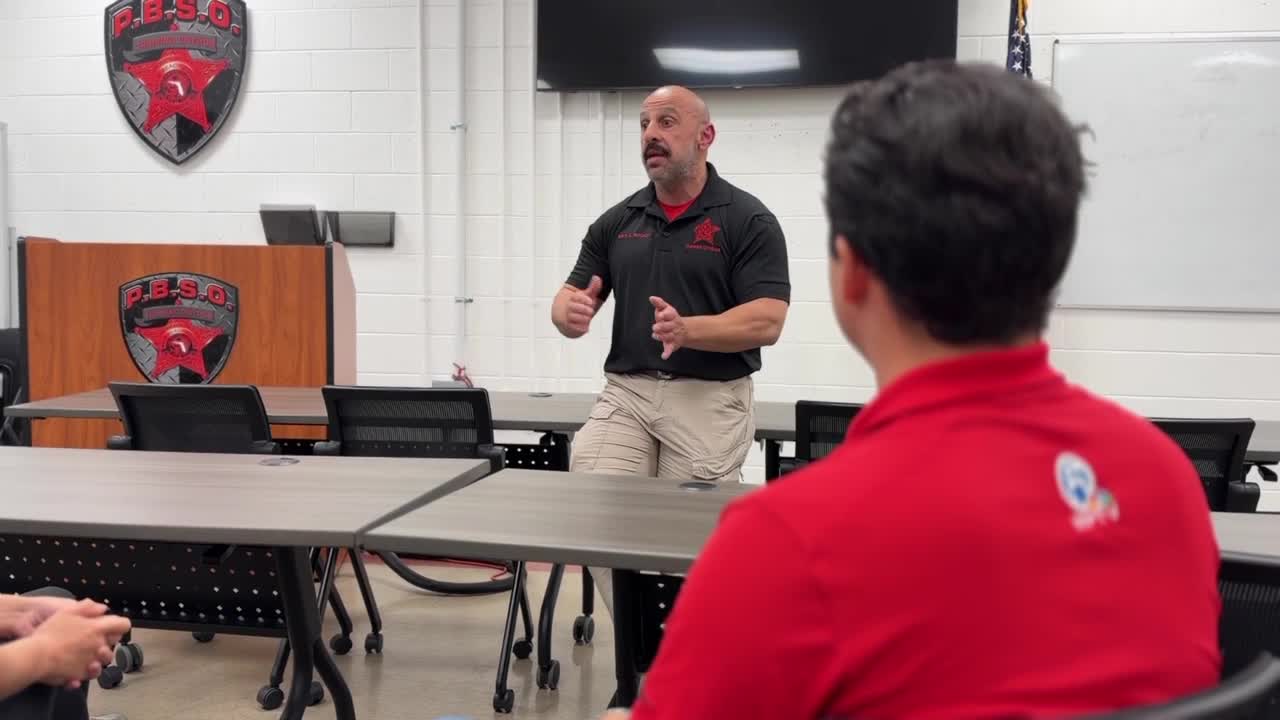
Before Hoffman entered the simulator, trainers sat him down in a classroom and explained what he could expect.
Deputies then walked him through the equipment available during training.
"We have every weapon platform that we have here," Capobianco said.
The options include handguns, shotguns and rifles, along with Tasers and other less-lethal devices.
Then, it was Hoffman's turn.
He went through multiple simulated encounters designed to test how he would respond under pressure.
But the scenario that stood out most did not require him to use a weapon at all.
When the most important tool is your voice
The scenario involved a man standing on a highway overpass and threatening to throw a baby.
Hoffman's primary tools were his voice and his ability to de-escalate the situation.
"Has this gone too far already, or is there a way out?" the simulated man asked.
"You're not too late," Hoffman responded. "Let's just take a breath and slow this down a little bit, OK?"
After the scenario ended, trainers immediately began breaking down what happened and why.
"You controlled the situation, right? You verbally made sure that he was making contact with you," one trainer told Hoffman.
The trainer pointed specifically to Hoffman's decision not to immediately introduce a weapon into the encounter.
"You took the time to de-escalate the situation without having to escalate things even further by the mere presence of drawing your weapon," the trainer said.
Breaking down the decision after the pressure stops
That debrief is part of the training.
Rather than simply running deputies through a scenario, trainers can walk through the decisions made during an encounter and examine how communication or tactical choices affected its direction.
For Hoffman, the experience showed how quickly emotion can become part of a critical encounter.
"I'm sure that everyone's been in a situation where they're really emotional and they're not seeing rational thought, and they have the thought to do something crazy," Hoffman said after the exercise. "But it just takes someone to take an extra second, be like, 'Hey, life is still going on. Just slow down, man.'"
The scenario was simulated. The adrenaline and stress were not.
And following five deputy-involved shootings in recent months, the exercise offered a firsthand look at one way PBSO trains deputies for situations in which they may have only seconds to determine what happens next.
This story was reported on-air by a journalist and has been converted to this platform with the assistance of AI. Our editorial team verifies all reporting on all platforms for fairness and accuracy.
