

PORT ST. LUCIE, Fla. — Residents in a Port St. Lucie neighborhood are cleaning up after an EF-0 tornado touched down Sunday, and some say the weather alerts meant to warn them either arrived too late — or never came at all.
The National Weather Service issued a Tornado Warning for portions of St. Lucie County at 6:28 p.m. after the initial tornado reports in Port St. Lucie.
Watch report from Zitali Solache
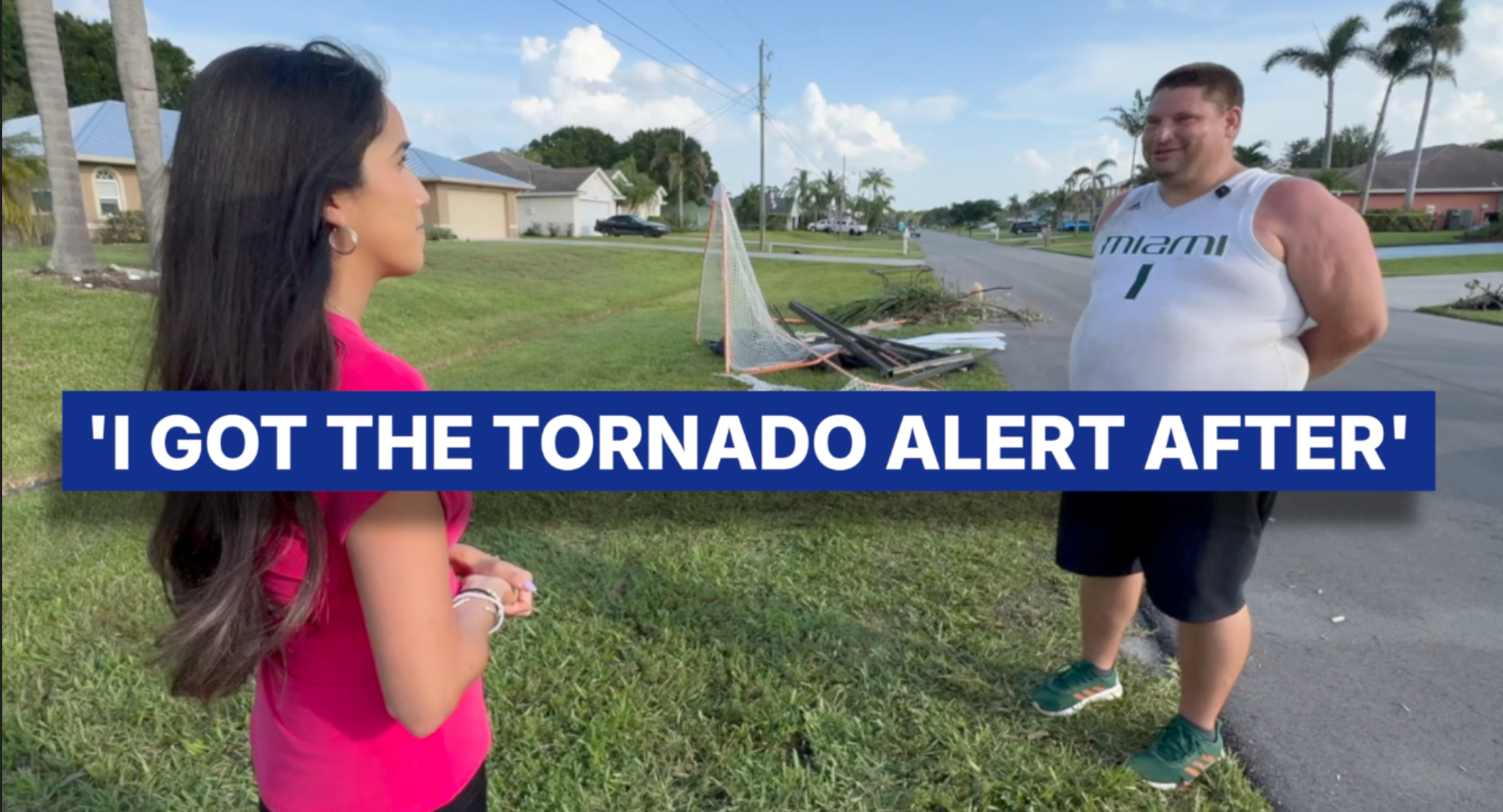
Aron Christiansen said his alert came in at 6:28 p.m., 6 minutes after the tornado had already passed his home.
"It's crazy like, I got the tornado alert after it hit my house. Was outside looking around and got the alert its like tornado warning, yeah, no kidding," Christiansen said.
One day after the storm, Christiansen was already working to clear the damage.
"Made progress getting some of the lanai down," Christiansen said.
He described the difference between preparing for a hurricane versus a tornado.
"Hurricanes — we get days to prepare, and tornado we had all of 10 seconds," Christiansen said.
Neighbor Theresa Garone said she never received an alert.
"It's scary, it is, cause we don't get any warning for that," Garone said.
"My nephews phone went off for a tornado, but my phone never went off. so I don't know if it was like — I don't know what happened," Garone said.
The NWS said about 145,000 people were in the Tornado Warning area, though the agency does not track how many individuals ultimately received alerts through the various dissemination systems.
Once issued, the warning was distributed through multiple channels, including NOAA Weather Radio, the Emergency Alert System on television and radio, Wireless Emergency Alerts on compatible mobile devices, and local notification services such as ALERT St. Lucie. The NWS said the exact time an individual receives an alert can vary depending on the dissemination system, cellular provider, device settings, and local notification service.
The NWS said it had no known technical or dissemination issues with its systems related to this warning. Officials said the tornado was a small, shallow circulation that was not well-sampled by radar. Unlike stronger tornadoes associated with rotating thunderstorms, landspouts typically develop from rotation near the ground that stretches upward beneath a developing thunderstorm. Because these circulations can be very small and short-lived, they can be difficult for radar to detect — particularly at greater distances from the radar site.
In comparison, the NWS said radar can often detect tornadoes associated with stronger, deeper rotation within a thunderstorm higher in the atmosphere before a tornado develops at the ground, sometimes providing more advance warning. Atmospheric conditions at the time remained favorable for the development of additional landspouts or waterspouts in the area.
Last year, investigative reporter Kate Hussey uncovered flaws in Florida's tornado alert system, where thousands of people received alerts too late as a tornado struck Martin County in October 2024.
Resident Scott Appell said timely alerts matter.
"From what I saw, that is important," Appell said.
Appell acknowledged that while improvements could be made, the unpredictable nature of weather presents its own challenges.
"Technology can always be improved," Appell said. "I just don't know how it's going to be fast enough to relay to people."