

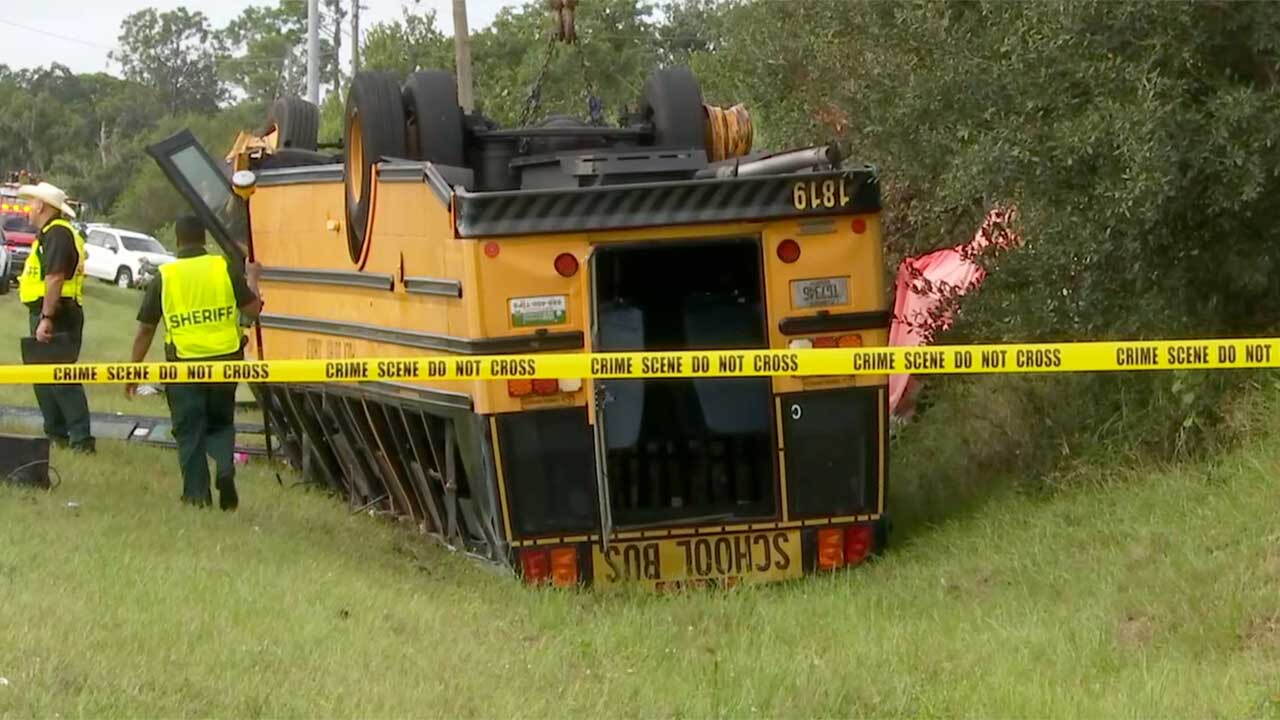


TAMPA, Fla. — A deadly school bus crash in Polk County is raising new questions about how students are protected when a bus rolls over, including whether wearing a seat belt could create an additional danger.
WATCH: AN NTSB EXPERT WEIGHS IN ON SCHOOL BUS SEAT BELTS
Two weeks after the crash, investigative reporter Katie LaGrone put that question directly to Dr. Kristin Poland, a school bus safety expert with the National Transportation Safety Board.
The crash killed 16-year-old Adinaluz Prieto Oyola during the morning commute on Oct. 5. According to investigators, the school bus carrying 37 high school students was on its way to Winter Haven High School when another cut slammed into its rear, causing the bus to collide head-on with another vehicle and flip over.

Following the crash, Polk County Sheriff Grady Judd was asked whether any of the dozens of students aboard were wearing seat belts at the time of impact.
"Quite frankly, if you try to make everyone put a seat belt on, then we would have had 37 kids hanging from the roof by a seat belt," Judd said.
His comments raise a key safety question: In a rollover crash, do seat belts protect students or potentially put them at greater risk?

While Poland said the NTSB cannot yet discuss specifics of its investigation into the Polk County crash, she pointed to what the agency has learned from other school bus crashes.
"The real risk is when they’re violently thrown during the crash sequence about the inside of the bus, where they hit other occupants, or they could potentially hit hard points inside the school bus," Poland said.
According to Poland, properly worn three-point restraints, which include both a lap and shoulder belt, provide the best protection even when a bus overturns.
"Those seat belts are designed so that students can still release the belts even if they're under tension, like if a student is hanging from the belt," she said.

Poland acknowledged that the image of a child hanging by a seat belt after a rollover may sound frightening. But she said the greater danger comes during the crash itself, when an unrestrained student can be thrown around the bus.
The NTSB has not determined whether a three-point seat belt could have changed the outcome of the Polk County crash. The school district confirmed the bus involved was only equipped with lap belts as are all the school buses in its fleet, according to a district spokesperson.
A safety issue investigated for years
For reporter LaGrone, the questions surrounding school bus restraints aren't new. More than a decade ago, she investigated a St. Lucie County school bus crash that killed 9-year-old Aaron Beauchamp, who was wearing a lap belt at the time.
The NTSB investigated that crash and produced simulations demonstrating the difference between the protection provided by a lap belt and the protection provided when a shoulder belt is added.
A few years later, the agency formally recommended that school districts in the U.S. upgrade school bus restraints to include both lap and shoulder belts. Florida was among the states called on to make three-point seat belts state law.
What does Florida require?
Currently, Florida only requires school buses to be equipped with lap belts, but students are not required to wear them.
Nearly a decade after the NTSB's recommendation, Poland said some Florida school districts are moving toward three-point lap-and-shoulder belts. “We're seeing some progress with some of the school districts in Florida moving to the passenger lap shoulder belts,” she said.
But our investigation found that the majority of public school buses in the state still have lap belts only.
Cost is one hurdle. Still, Poland said installing the equipment is only part of improving student safety.
"It's not enough just to have the lap shoulder belts on the bus, there also has to be an entire layered approach to ensure that the students are wearing the belts properly," she said. That approach also requires involvement and oversight from school districts and parents, Poland said.
But Poland wants to emphasize that school buses remain the safest mode of transportation for students traveling to and from school, regardless of what kind of seat belts are on board. For Poland, seat belt use on school buses is a major step toward the agency's ultimate goal.
"We think we can get to zero fatalities in school buses and that's what we're looking towards," Poland said.