

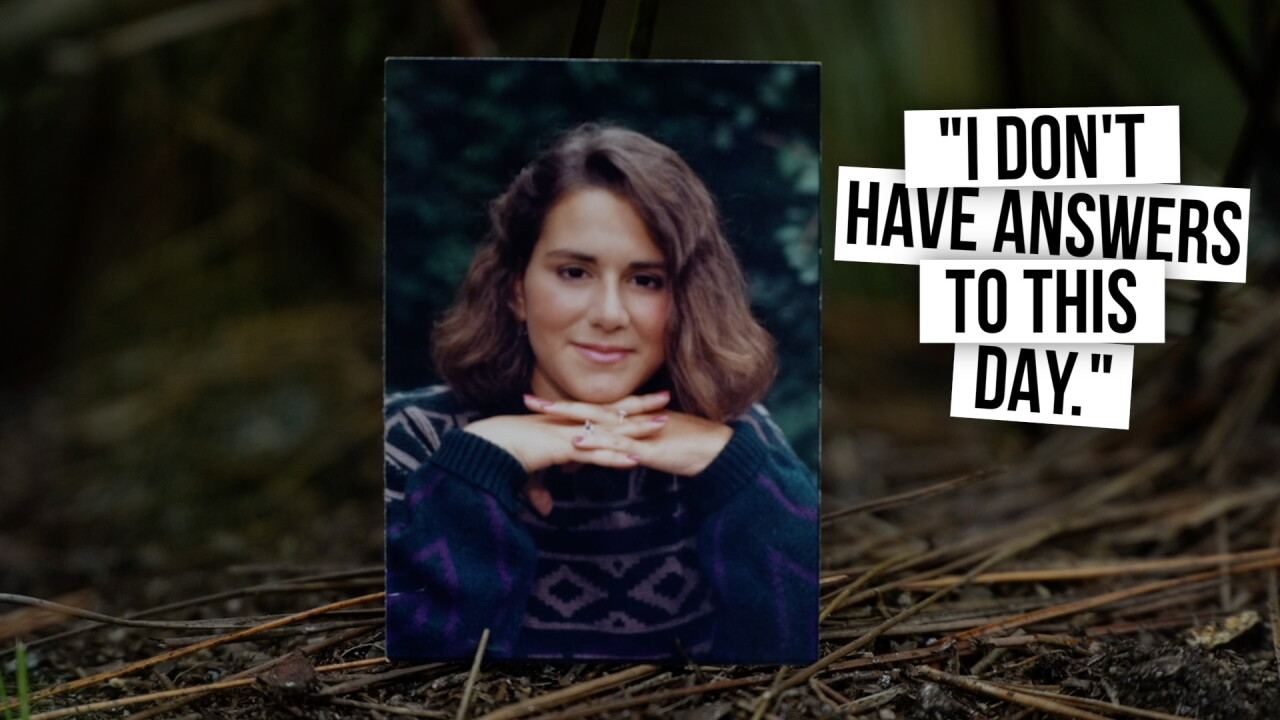


STUART, Fla. — Beth Miller sits alone on a bench in a Port St. Lucie park, surrounded by trees, birds and the quiet sounds of nature.
But for Beth, the stillness leaves plenty of room for memories.
She comes here thinking about her daughter, Dawn, the daughter who once sat beside her in places just like this.
WATCH THE STORY BELOW:
Now, Beth is left searching for answers about how Dawn died — just hours after she was discharged from Cleveland Clinic Martin North Hospital following gallbladder surgery.
Dawn Miller was admitted to Cleveland Clinic Martin North Hospital on Feb. 24, 2024. Four days later, despite troubling symptoms, she was discharged. She died within hours of leaving the hospital.
"She went in for gallbladder surgery and she died four days later," Beth said.
Dawn was 49 years old. She died two days before her birthday.
"Yeah, it's tough. We celebrate the day of her death, and then two days later we celebrate her birthday," said Beth.
Medical records Beth shared with WPTV show Dawn was admitted to the hospital with abdominal pain. She underwent emergency surgery the following day, Feb. 25, 2024, to remove her gallbladder. Two days later, pathology confirmed she had gangrenous cholecystitis — a severe and life-threatening gallbladder condition.
The post-operative report states Dawn "tolerated the procedure well," was returned to the recovery room in stable condition, and was later described as "alert, cooperative, and had no fever."
The next day — Monday, Feb. 26 — records show Dawn's hemoglobin, a measure of red blood cells that carry oxygen, dropped.
Clinical documentation shows a hospital employee sent a formal query the following afternoon — Feb. 27 — asking Dawn's doctor to confirm whether she had severe sepsis, a life-threatening response to infection in which the body starts damaging its own tissues.
About an hour and 15 minutes later — at 1:24 p.m. — the response was sent back, checking the box next to "severe sepsis with acute lactic acidosis, present on admission." Underneath that, a notation states it was electronically signed by her doctor, who then ordered her antibiotics to be continued.
Later that day, a doctor wrote in a hospital course note that Dawn's hemoglobin "was further low," noting she became "symptomatic": "pale and short of breath."
Thirty minutes later, a nurse documented Dawn would "be discharged" that day, writing her vital signs were stable. But 90 minutes after that, another nursing note said Dawn declined discharge, telling staff she felt "weak" and "not ready" to go home.
Beth described a phone call she received from Dawn that Tuesday night.
"She called me Tuesday night, and she was completely delirious. I couldn't understand a word she was saying, so my husband drove me down to the hospital. I spent the night. She was up all night screaming, I'm not going to die tonight," Beth said. "She was soaking wet. She was burning up."
Dawn's inpatient records show that overnight, she refused an antibiotic and underwent more bloodwork.
At 8:56 a.m. the next morning — Wednesday, Feb. 28 — a hospital course note states Dawn again refused to leave the hospital, but that after speaking with a nurse, agreed to leave.
Hospital records show Dawn's discharge was officially processed at 9:16 a.m. Beth says within minutes of getting home, her daughter collapsed.
"I couldn't get her up. I got her to crawl into the house, and she belly flopped onto the sofa," Beth said.
A nursing note states Beth watched her daughter go into cardiac arrest and immediately started CPR.
"Panic, complete panic. And I was alone," Beth said. "I was calling 911, and they were telling me to roll her on the floor and start giving her chest compressions."
"And I just felt so helpless, you know, and then you're staring at your daughter trying to do CPR, and nothing's happening, and it seemed like it was forever that the Fire Rescue didn't get there and she was just laying there," Beth said. "She was dead about 10 or 15 minutes later."
By 10:40 that morning, emergency records show Dawn was back at Cleveland Clinic Martin North with no pulse. Staff immediately began chest compressions, but at 11:11 a.m., she was pronounced dead.
Beth said she immediately requested an autopsy.
"A bunch of people wandered in and out to say how sorry they were. And I demanded an autopsy. I wanted an autopsy. And they said, that's not a problem. We'll give you an autopsy. We'll get her an autopsy," Beth said.
Records back that up. Two nurses documented that Beth requested an autopsy before Dawn was sent to the morgue.
But hours later, a nurse manager wrote that "the medical examiner released the body" and "was not requiring an autopsy."
The note states Beth remained "adamant that she wants an autopsy completed" — but was told the hospital "could not make that decision" and that her request "would be documented in the chart that she was requesting the autopsy but could not pay."
"She never got an autopsy," Beth said.
Records show that by 12:30 that afternoon, hospital staff had already contacted LifeLink Tissue Bank in Tampa. By that evening, Dawn's body was removed from the hospital for an off-site tissue donation, with records stating the "body will not return to the hospital."
"I couldn't believe it. They had to put her — as soon as we left, they sent her to Tampa. There was no autopsy. There was nothing," Beth said.
In a clinical note written after Dawn's death, the attending physician said he suspected she suffered a massive cardiac arrest. After he "reviewed her records," he said she "had normal chemistries" — but made no note of the cholecystitis diagnosis, the sepsis query, or the drop in hemoglobin.
Dr. Gerald Feigin, a forensic pathologist and medical examiner who has spent more than 40 years performing autopsies in New Jersey, reviewed Dawn's medical records.
"I've done over 25,000 [autopsies] in my career," Feigin said.
When asked whether Dawn's chemistries were normal, as per the assessment of the attending physician, his response was direct.
"No, absolutely not, because they're not normal," Feigin. "Looking at the CBC, the blood count, that wasn't normal."
Feigin was referring to bloodwork taken five hours before her discharge on Feb. 28 — labs marked "abnormal," with at least eight components flagged as either high or low. A basic metabolic panel taken at the same time was also marked "abnormal," and Feigin said those results indicated low kidney function.
"Her kidney function went right down. So it was not good," Feigin said.
Feigin was most concerned about the drop in Dawn's hemoglobin. Though records show her doctor ordered a blood transfusion the day before discharge, by the next morning her hemoglobin had risen slightly — but only to 8.2. The Cleveland Clinic's own website states a hemoglobin below 12 in women is "a severe low level," meaning her body wasn't getting enough oxygen.
"That's a red flag. People are weak after surgery, but don't — I mean, the hemoglobin dropping that rapidly, that's a red flag. I mean, that's glaring," Feigin said.
When asked directly whether Dawn should ever have been discharged, Feigin did not hesitate.
"No, absolutely not," Feigin said. "When somebody's losing hemoglobin that rapidly, you better figure out why, and they shouldn't be discharged."
Feigin also addressed the cardiac arrest Dawn suffered within hours of leaving the hospital.
"Absolutely," Feigin said when asked whether it was likely tied to the conditions documented in her records. "But that's why you do an autopsy. The hospital should have done an autopsy, plain and simple."
Cleveland Clinic was contacted for comment. The hospital said it could not comment because it is bound by patient privacy laws. When asked to explain its discharge policies and when an autopsy should be performed, the hospital again declined to answer those questions or address Feigin's concerns.
Dawn's treating physicians were also contacted — including the doctor who discharged her, her attending physician, and the emergency physician who pronounced her dead and reviewed her lab results. None responded to our calls or emails requesting an interview.
Records from the Florida Department of Health show no public complaints or disciplinary actions against any of the doctors involved. Additional records from the Agency for Health Care Administration show no disciplinary action against the hospital.
Feigin makes it clear: we will never know for certain whether Dawn would have survived, or what ultimately caused her death.
"It's on your mind, 24/7," Beth said. "It's very difficult. It will always be difficult. I see her laying on that floor all the time."
But even if Beth had those answers, her legal options would be limited under Florida's Free Kill law — specifically, state limits on who can sue for wrongful death. That will be the focus of WPTV's follow-up investigation.
If you have had a similar experience, we invite you to share it with us.
This story was reported on-air by a journalist and has been converted to this platform with the assistance of AI. Our editorial team verifies all reporting on all platforms for fairness and accuracy.