

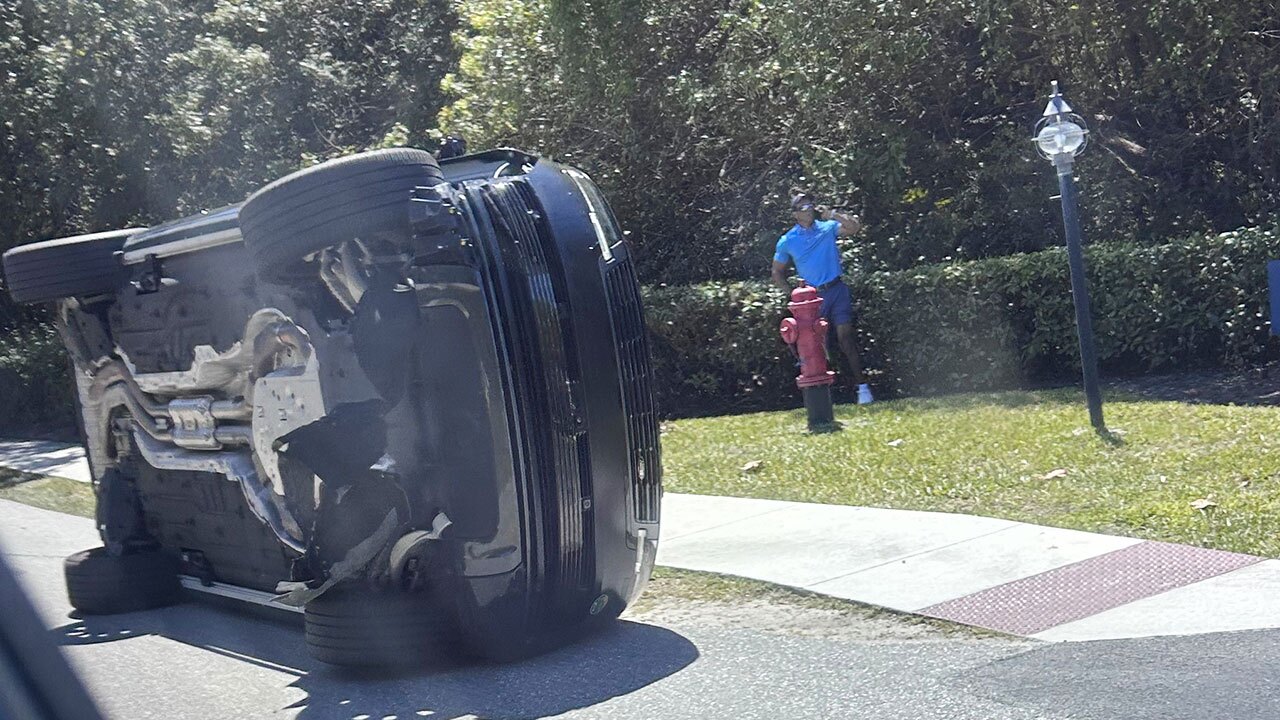

Tiger Woods' refusal to take a urine test following his recent rollover crash can be prosecuted under a change to Florida law last year, and prosecutors can build a DUI case against him even without lab results by utilizing deputy testimony, and body camera and dashcam video, according to a legal expert.
The golfer was traveling at "high speeds" on a beachside, residential road in Jupiter Island on Friday when his Land Rover clipped a truck and rolled onto its side, according to the Martin County Sheriff's Office, noting that Woods showed "signs of impairment."
Investigators believe Woods, who wasn't injured, had taken some kind of medication or drug and described him as lethargic. He agreed to a Breathalyzer test that showed no signs of alcohol, but he refused a urine test, authorities said. He was arrested and released on bail eight hours later.
Woods' agent at Excel Sports, Mark Steinberg, didn't immediately respond to a Monday text message or phone call seeking comment. No one from Woods' camp or the PGA Tour -- he is on the board and is chairman of the committee reshaping the competition model -- has commented since his arrest.
Here's what to know about the case:
Woods is charged with refusing the test, among other things
Woods, who has been involved in other crashes over the years, is charged with driving under the influence, property damage and refusal to submit to a lawful test.
Under the change to Florida law, refusing a law enforcement officer's request to take a breath, blood or urine test became a misdemeanor, even for a first offense. Refusal was previously only prosecuted if a driver had refused to take a test during a prior incident — which incentivized people facing DUI charges to refuse the test.
"Now, it doesn't matter if you refused previously or not," said David Hill, an Orlando defense attorney who isn't involved in Woods' case.
'We will never get definitive results'
Martin County Sheriff John Budensiek told reporters that Woods was cooperative when he talked to investigators after the accident, but that he chose his words carefully.
"And when it came for the urine tests at the jail, he stopped that," Budensiek said.
Woods had a right to refuse the test, but as a result, he was charged under the new Florida statute, the sheriff said.
"We will never get definitive results about what he was impaired on at the time of the crash," Budensiek said.
Still, prosecutors can draw on other evidence to build their case even if they don't have any lab results, which could have determined which drugs, if any, he had in his system, Hill said.
Deputies performed roadside tests on Woods that seemed to show he was impaired, the sheriff said. Any bodycam video or testimony from the deputies indicating that the golfer had red or bloodshot eyes, displayed slurred speech or smelled like he had been using drugs or alcohol could bolster prosecutors' cases, according to Hill.
That said, the lack of lab results presents an opportunity for Woods' attorneys.
"It's kind of our bread and butter if there's nothing scientific, no breath results or urine results to look at," Hill said.
A second DUI matters
In Florida, Woods would have had a good chance of getting his case dismissed if he hadn't clipped the other vehicle or if it had been his first offense. First-timers who aren't involved in an accident are often allowed to go through a diversion program involving education and community service that results in the charges being dismissed. Prosecutors also regularly allow first-time DUI offenders to plead to the lesser charge of reckless driving, Hill said.
But Woods was arrested in 2017 for a DUI. At the time, Woods said he had taken a bad mix of painkillers when authorities found him asleep behind the wheel of his car, the engine still running and its driver’s side damaged. Woods pleaded guilty to reckless driving.
"If the person has priors or the case is aggravated for some reason, the prosecutor might be pushing for jail. And those are cases that generally go to trial," Hill said.
