



PORT ST. LUCIE, Fla. — Port St. Lucie City Council is looking ahead to a sweeping infrastructure plan to address traffic congestion and accommodate rapid population growth — but the city acknowledges a significant funding gap remains.
The 2050 Mobility Plan carries a $2.2 billion price tag and serves as a road map for building infrastructure projects through 2050.
WATCH BELOW: $2.2B mobility plan aims to keep up with Port St. Lucie growth
Those projects include new and improved roads, sidewalks, trails, bike lanes and transit.
The city said more than 65,000 people have moved to Port St. Lucie since 2020.
Residents like Laura Milsom said the growth is impossible to ignore on local roads.
"We're not in love with the traffic situation," Milsom said.
Milsom said that the rapid expansion has come with consequences.
"The population increased so rapidly," Milsom said. "A lot of traffic backups."
On Monday, City Council members approved the first reading of the Mobility Plan, updating the mobility fee schedule for the next four years and outlining the broader 25-year vision.
Mayor Shannon Martin acknowledged the challenge growth presents to city finances.
"We know that growth has never paid for itself," Martin said.
The infrastructure projects in the plan are funded by mobility fees, which are applied to new development and paid by developers — not homeowners.
Milsom said she supports that approach.
"Anyone wanting to come in and develop in the area should be partly responsible for how the traffic is managed and everything," Milsom said.
Despite the fee structure, the city says the plan is still $1.7 billion short of full funding. A city official addressed the gap during the council meeting.
"We fully know that there's not enough money to fund every single project that's in the mobility plan. But the mobility plan is intended to say, through 2050, here's the needs that we see based on our analysis today. And so it's, it can't solve all of the problems funding-wise, but it's a piece of the puzzle," the official said.
Scott Samples with the City of Port St. Lucie said increasing mobility fees is one way to help fund future projects.
"They're one of the tools in our toolbox," Samples said. "Help create the funding necessary to build the infrastructure that we need to, you know, maintain, but also to grow."
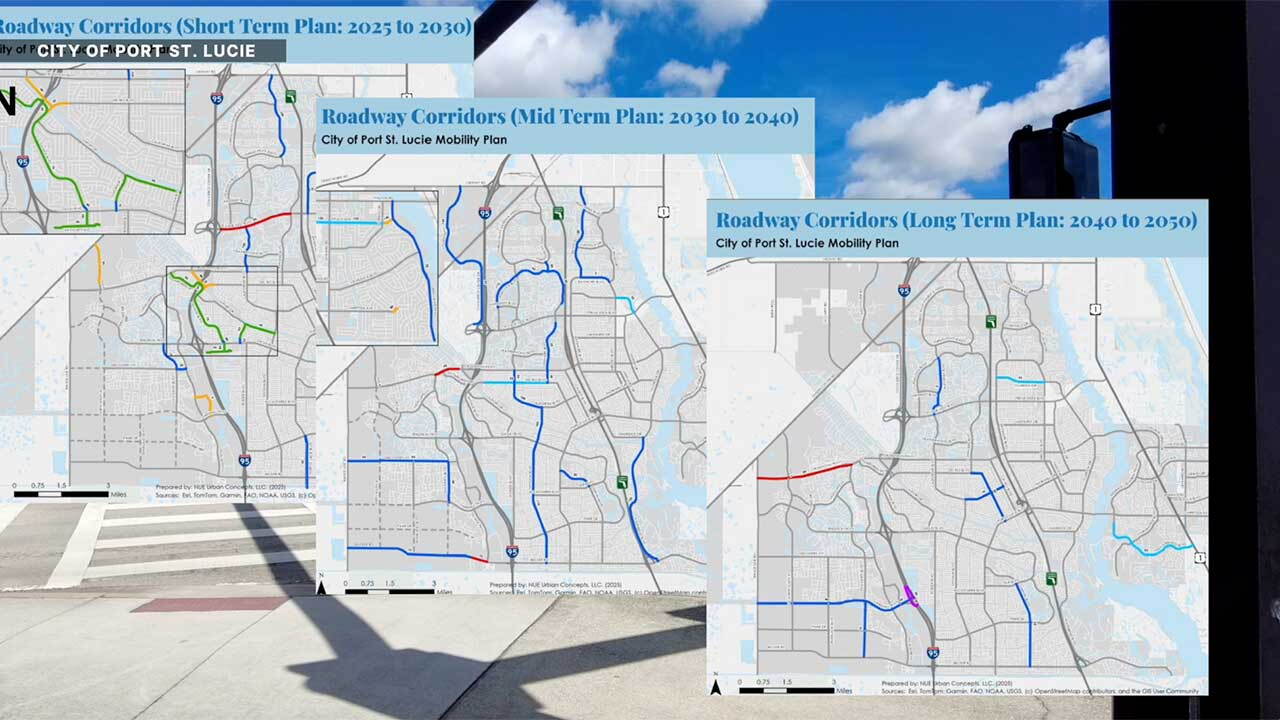
The plan breaks infrastructure improvements into short-, mid-, and long-term projects.
Short-term projects look ahead to 2030 and include expanding St. Lucie West Boulevard from four to six lanes.
"Mobility fees may need to supplement that," Samples said.
The updated plan still requires final approval from the City Council before taking effect on Dec. 31.
This story was reported on-air by a journalist and has been converted to this platform with the assistance of AI. Our editorial team verifies all reporting on all platforms for fairness and accuracy.

