

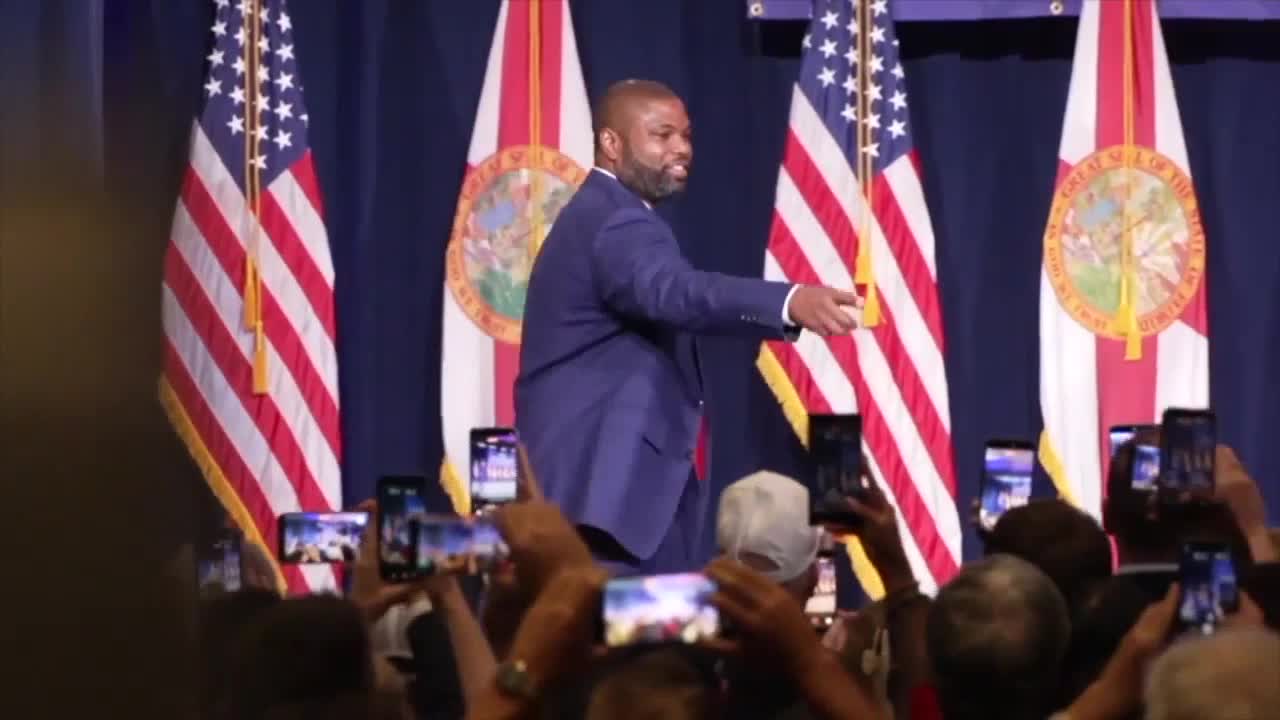


TALLAHASSEE, Fla. — With the Republican nomination secured, Byron Donalds is moving from winning the primary to defending the policy fine print.
In a recent one-on-one interview, Donalds outlined his positions on four issues likely to follow him into November: property taxes, insurance, school vaccine requirements and data centers.
The first three help define his governing pitch. The fourth is already opening a sharp divide with Democratic nominee David Jolly.
Watch report from Forrest Saunders
Property-tax relief, with more promised
Donalds supports Amendment 3, the property-tax proposal headed to voters this fall, but calls it only a first step.
The measure would increase the non-school homestead exemption to $150,000 in 2027 and $250,000 in 2028 for Floridians who establish permanent residency by the end of 2026. It would also lower the annual assessment-growth cap on non-homestead properties from 10% to 5%.
New residents would face a five-year phase-in before qualifying for the full exemption.
The Florida Division of Elections lists the measure under the revised title, “Increased Homestead Exemption; Lower Cap on Increases in Non-Homestead Property Assessments.” A judge ordered the original title and summary rewritten after finding the wording misleading.
Donalds said the amendment would provide needed relief, particularly for seniors and working families, but suggested Florida should eventually consider a system that treats counties differently based on property values and economic output.
“It might be time for Florida to have a multi-tiered taxing system,” Donalds said, contrasting large counties such as Miami-Dade and Orange with smaller counties including Putnam, Wakulla and Gadsden.
He did not spell out how the tiers would work or how local governments would replace lost revenue.
A legislative financial analysis estimates Amendment 3 would reduce local non-school property-tax revenue by nearly $5 billion in its first full fiscal year. The recurring impact is projected to approach $11.9 billion by the 2031-32 fiscal year.
The amendment needs approval from at least 60% of voters.
Insurance: A 20% to 25% pledge
Donalds is making an ambitious promise on property insurance, saying regulatory changes could lower costs by another 20% to 25%.
“We have to reform the regulatory side of insurance in our state,” Donalds said. “We think we can push costs down in Florida another 20 to 25%.”
His ideas include changing the Florida Hurricane Catastrophe Fund, lowering reinsurance costs and making home-hardening grants more efficient.
Donalds specifically pointed to the catastrophe fund’s 25% cash buildup factor, which insurers pay on top of actuarially calculated premiums. Florida law has required the factor since the 2013-14 contract year.
Donalds said the state could eliminate the charge or create a formula that turns it down when the fund has healthy reserves and raises it when the balance falls.
The detailed proposal is still coming. Donalds did not provide an independent analysis showing how the changes would produce the promised savings or how quickly homeowners would see them.
Vaccines: More choice, but not a full repeal
On school vaccines, Donalds is taking a more cautious position than Gov. Ron DeSantis and Florida Surgeon General Joseph Ladapo, who have pushed to eliminate all childhood vaccine mandates.
Donalds supports giving parents more discretion and spreading vaccinations over a longer schedule. But he stopped short of endorsing the elimination of core requirements for polio and measles, mumps and rubella, commonly known as MMR.
“In terms of polio vaccines or measles or mumps or rubella, there’s more study, there’s more data I want to look at before that decision is made,” Donalds said.
Florida’s standard school requirements remain in place. State law requires immunization against polio, diphtheria, measles, rubella, pertussis, mumps and tetanus. A 2026 effort to expand exemptions passed the Senate but stalled in the House.
Donalds’ position still favors more parental choice, but leaves him short of the complete rollback sought by Florida’s current governor and surgeon general.
Data centers become the main event
Donalds is standing behind data-center development despite resistance from both parties.
He argues the facilities are necessary infrastructure for artificial intelligence, aerospace, medicine, government services and other parts of Florida’s future economy. He also warns that bans and moratoriums could send investment and high-paying jobs elsewhere.
“Capital goes where it’s valued,” Donalds said. “When you start throwing out the word ban or moratorium, what you’re really saying is that maybe Florida is not the place to do business.”
Donalds would allow the facilities with safeguards. His proposals include closed-loop water-cooling systems, protections for residential utility customers and restrictions keeping large centers away from homes.
Florida already enacted Senate Bill 484, which preserves local zoning authority, requires additional water-use review and is intended to prevent utilities from shifting data-center costs onto other ratepayers.
Donalds’ position survived Republican primary attacks. Paul Renner supported a temporary statewide pause, while James Fishback proposed an outright ban.
Now Jolly is carrying the dispute into the general election.
Jolly has proposed a statewide moratorium while Florida studies environmental protections, long-term economic effects and privacy and security concerns connected to AI.
“The environmental protections are not in place,” Jolly said in an online video. “The data centers are rushing in before Florida has the appropriate regulations in place.”
Jolly also tied Donalds’ position to campaign money, alleging that the Republican nominee “has been bought by too many special interests, including data centers.”
A Seeking Rents analysis of state campaign-finance records estimated that roughly $5.8 million in donations and outside spending connected to AI investors, utilities and data-center interests had benefited Donalds. That included $3 million from a federally registered super PAC backed by AI investors to a state committee promoting Donalds.
The analysis used a broad definition of data-center interests that included utilities, technology investors and development companies. The campaign-finance records establish the contributions and spending, but do not by themselves prove Jolly’s allegation of corruption.
National polling shows a local-opposition problem
National polling suggests data centers may be a difficult sell when residents are asked about construction close to home.
A Gallup survey released in May found 71% of Americans opposed building an AI data center in their local area, including 48% who strongly opposed it.
A newer Heatmap Pro poll found 75% would oppose a new data center near where they live, with more than six in 10 strongly opposed.
Neither poll measured Florida voters specifically.
That leaves the state’s major-party nominees with a clear November split. Donalds says regulate the industry and build. Jolly says pause, study and reconsider.
Florida voters will decide which approach they prefer on Nov. 3.
Share Your Story with Forrest
Capitol Reporter Forrest Saunders is dedicated to sharing your voice with political leaders throughout the state. He works to hold our elected leaders accountable and amplify your concerns. Let Forrest know about the issues you want state leaders to focus on.
.
